

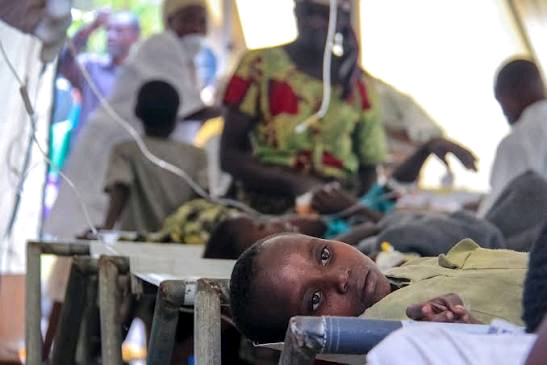
Residents on the outskirts of Kinshasa, the capital of the Democratic Republic of Congo (DR Congo), have expressed concerns over heightened safety risks following the confirmation of three new cholera cases amid a renewed outbreak.
More than 60,000 cases of cholera have been recorded in the Democratic Republic of the Congo (DRC) since the beginning of the year — including 1,800 deaths.
According to World Health Organisation (WHO) Director-General Tedros Adhanom Ghebreyesus, the situation accounts for the “worst cholera outbreak in decades” in the central African country.
The mortality rate to date in 2026 stands at around 3%, which the WHO says is quite high for cholera.
Most of the infections so far have been detected in the eastern provinces of North and South Kivu.
Both regions have long been plagued by guerrilla warfare waged by a multitude of armed groups, in particular rebels belonging to the Rwanda-backed M23 militia.
Parts of the region are now under the control of the insurgents, who are now tasked with addressing and coordinating public health measures.
These circumstances make a nationwide, government-coordinated response to the epidemic significantly more difficult, especially in North and South Kivu.
At the same time, the DRC is also facing the deadliest Ebola outbreak in its history, making public health one of the main priorities at the moment.
Following the cases in North and South Kivu, further reports of cholera emerged along the Congo River basin.
Most recently, three cases were reported in Kingabwa in the east of Kinshasa. Many worry that the ongoing rainy season could further facilitate the spread of the waterborne disease.
Fears of a fresh cholera outbreak are growing among residents of Kinshasa, the capital of the DR Congo.
A report by DW quoted some residents as saying that many people are now “afraid” amid concerns over the renewed spread of the disease.
“We wash our hands after every contact. Cholera is a disease that kills quickly,” the man said, not wanting to share details about his name or identity.
Another resident told DW that he was concerned because “there are no health authorities in Kinshasa” — although strictly speaking, this isn’t true.
Kinshasa’s health authority, Division Provinciale de la Santé (DPS), is either unknown to some residents or does not have a good reputation following previous public health crises.
During the last outbreak in February 2026, over 80% of infections were concentrated in the five Kinshasa health districts of Limete, Kingabwa, Kalamu II, Binza Ozone, and Kingasani.
The WHO fears that the diarrheal disease could spread once again across the densely populated capital city, and that the DPS could become overwhelmed.
The Deputy Country Coordinator of Doctors Without Borders (MSF) in the DRC, Esther van der Woerdt, told DW that “the underlying problem often is the lack of access to safe drinking water and adequate sanitation,” adding that “poor hand hygiene can also contribute to transmission.”
“Cholera is primarily transmitted through the consumption of water or food that has been contaminated with the bacterium,” van der Woerdt explained, stressing that MSF had significantly strengthened its response to the cholera outbreak, especially across North and South Kivu.
“Our response is providing medical care, providing access to safe drinking water and sanitation, as well as cholera prevention in the communities,” she added.
She said authorities across Congo need to move away from their predominantly reactive approach to outbreaks, and focus on investing more in prevention.
Cholera leads to rapid dehydration and can, without sufficient medical care, be fatal — especially among vulnerable individuals and in overpopulated, poor communities.
Bernard Nsongolo, a senior doctor at a health centre in eastern Kinshasa, urges everyone living in such high-risk circumstances to “significantly step up hygiene measures.”
“Drink safe water, especially treated water that is well protected,” he told DW, stressing also that all food should be cooked thoroughly, and that raw vegetables and unpeeled fruit should be avoided.
