

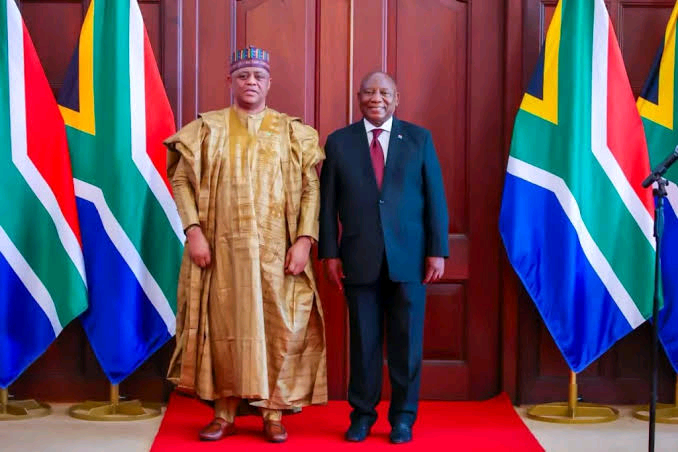
Nigeria’s high commissioner to South Africa, Femi Fani-Kayode, has revealed that he was initially posted to a European country but appealed to be reassigned to South Africa.
Fani-Kayode made the disclosure during a dinner and reception organised by the Nigerian high commission and consular office in Pretoria after the presentation of his letters of credence to President Cyril Ramaphosa on November 13.
“I was sent here by our president, Bola Ahmed Tinubu, president of the Federal Republic of Nigeria — 250 million strong, a massive country, resilient people with rich history, very proud people, hardworking people that love life and love their country passionately, and I’ve been sent to represent those people and our government in a country which is equally resilient, hardworking, decent, civilised, with an equally rich history and heritage, as we have,” he said.
“And we’ve all been through so much. And what’s important is this: it is important that we recognise the fact that together, South Africa and Nigeria can actually help to move sub-Saharan and Africa, in general, forward. We must not allow any division, we must not allow any misunderstanding, we must not allow even any slight issue to put us apart.
“And that’s why I chose this country. I was initially posted to a European country, and I made an appeal to our president that I preferred to go to South Africa which he graciously agreed to. So I find myself here.”
Fani-Kayode was initially posted as ambassador to Germany.
However, in May, he was reassigned to South Africa. At the time, Fani-Kayode said he had made a formal request to Yusuf Tuggar, then-minister of foreign affairs, about his discomfort with his Germany posting.
The former minister said he was not comfortable with Germany “for a number of personal reasons and given the fact that I had lived in Europe most of my life”.
“He said he prefered South Africa which he had never been to and he had “so much interest” in.
Ita Enang, who was originally posted to South Africa, was later reassigned to Germany in Fani-Kayode’s stead.
Neither the Nigerian nor German governments confirmed Fani-Kayode’s reported rejection of the appointment.
Fani-Kayode said from the time he arrived in South Africa, he began to look into some of the things that concerned the Nigerian community.
He described those responsible for xenophobic attacks in South Africa as a “tiny minority”, saying they do not represent the majority of South Africans, whom he characterised as decent and accommodating people.
The envoy reiterated that Nigeria would not sever economic ties with South Africa despite the clamour from Nigerians.
He said he would work to rebuild ties between the countries.
