

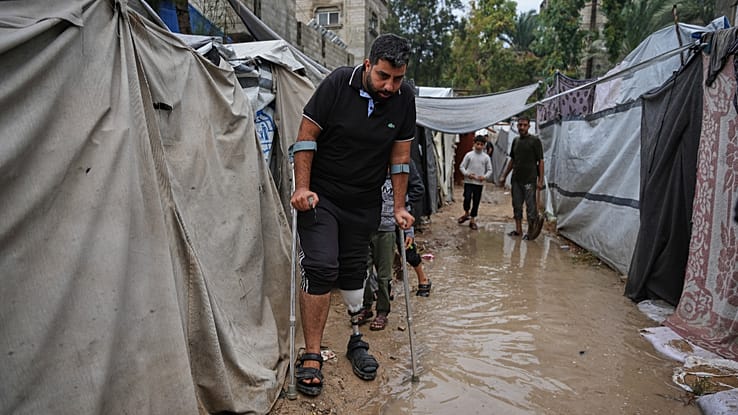
Heavy downpours on Saturday inundated tens of thousands of makeshift shelters housing displaced residents across war-torn Gaza, Palestinian authorities reported, stripping families of their basic shelter.
According to a statement released by the Hamas-run government media office, roughly 70,000 tents providing refuge to tens of thousands of displaced individuals were flooded during the initial day of rainfall. The office further reported the collapse of dozens of cracked walls and roofs, which caused injuries, including several critical cases, throughout the narrow territory.
Starting early Saturday morning, hundreds of uprooted families were forced to evacuate makeshift settlements in sections of Gaza City as well as the central and northern areas of the Strip after torrential rainwater overwhelmed their living spaces.
Civil defence spokesman Mahmoud Bassal told AFP that emergency personnel received over 1,500 urgent calls overnight from residents seeking assistance as water invaded their shelters. He highlighted that the service is operating without any equipment or capabilities.
“We have issued an urgent distress call to the international community and humanitarian organisations to intervene immediately to save hundreds of thousands of displaced people from the flooding of their tents,” Bassal said. “We cannot face the consequences of this storm on our own.”
The human toll of the storm is already severe for families enduring harsh winter conditions.
Um Muhammad al-Hersh, 45, who resides with her family in a tent located in western Gaza, told AFP: “We were not able to save the mattresses, and all the clothes were soaked. Our suffering is repeated every winter.”
Maryam Odeh, 34, living with her children in Deir al-Balah, shared her desperation: “We no longer know how to protect our children. My children ask me where we will sleep tonight, and I have no answer.”
Expressing deeper concerns over the worsening climate, Khaled al-Najjar, 41, added: “We fear for our children not only from the flooding of the tents, but also from the cold and the widespread diseases.”
A broad coalition of Palestinian civil society groups released a statement warning of the catastrophe that has come to threaten the lives of hundreds of thousands of residents, emphasizing the escalating threat of outbreaks and epidemics. The network, which brings together dozens of local organizations, called for pressure on Israel to allow the entry of humanitarian aid without restrictions.
A fragile ceasefire took effect on October 10, 2025, following two years of conflict sparked by the unprecedented assault carried out by Hamas on Israel on October 7, 2023. Despite the truce agreed upon through Egyptian, Qatari, and American mediation, Israeli forces persist with near-daily airstrikes and ground operations.
Mustafa Qazzaat, a member of the Gaza city council and an official serving on the territory’s emergency committee, stated that Israel has barred the entry of prefabricated housing units meant to shelter displaced families since the truce was announced, permitting only a limited quantity of tents to pass through.
Qazzaat told AFP on Saturday that Gaza needs 200,000 prefabricated homes urgently, in addition to the entry of heavy machinery to remove the rubble of destroyed homes and buildings, open main roads, and urgently provide electricity and heating.
