

Story from TITI AJAYI
ACCRA, Ghana — As dawn breaks over Jamestown Beach in Ghana’s capital, Beatrice begins another day confronting a growing environmental crisis that has become impossible to ignore.
The fish trader carefully separates her catch from piles of discarded clothing and plastic debris washed ashore overnight. What should be a routine part of her work has become an increasingly frustrating reality for many coastal residents whose livelihoods depend on the sea.
“The waste affects us every day,” Beatrice says. “Fishermen often return with fish tangled in textile waste and plastic. Before we can sell anything, we have to remove the rubbish.”
For communities along Ghana’s coastline, the global fast-fashion industry has created an environmental burden that stretches far beyond the shopping malls and retail stores of Europe and North America.
Each week, millions of second-hand garments arrive in Ghana, shipped from countries in the Global North and marketed as clothing for reuse. While some items find their way into local markets, a substantial portion is unsuitable for resale due to poor quality, damage, or excessive wear.
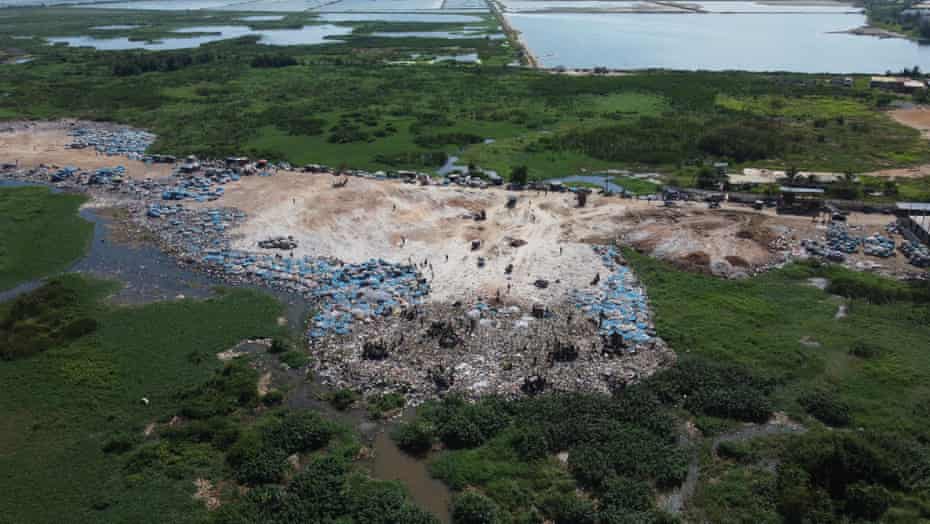
As a result, communities are left to deal with mounting volumes of textile waste that end up in landfills, drainage systems, waterways, and beaches.
Nowhere is the scale of the challenge more evident than at Kantamanto Market in Accra, one of the largest second-hand clothing markets in Africa. Traders purchase imported bales of clothing with the hope of making a profit, only to discover that many items are unsellable.
The consequences extend beyond economic losses.
Environmental experts warn that much of the waste consists of synthetic fabrics such as polyester, nylon, and acrylic, materials derived from fossil fuels that can take decades to break down. When dumped or burned, these textiles release pollutants that contaminate the air, soil, and water, posing potential risks to public health and ecosystems.
The impact is increasingly visible in coastal communities where textile waste has become part of the landscape. Beaches are littered with discarded garments, while blocked drainage channels contribute to flooding during periods of heavy rainfall.
For fishing communities, the problem directly affects livelihoods. Fishermen report bringing ashore nets entangled with waste instead of productive catches, while traders face additional costs and delays sorting through contaminated fish.
“This is no longer just a waste management issue,” environmental advocates say. “It is a social, economic, and environmental challenge that affects entire communities.”
Despite the growing crisis, local organisations are working to create solutions. Community groups and social enterprises are training young people to transform discarded textiles into reusable products, including bags, accessories, and fashion items.
These initiatives are helping to create jobs while reducing the volume of waste entering the environment. However, experts caution that recycling and upcycling alone cannot keep pace with the sheer quantity of discarded clothing arriving in the country.
At the heart of the problem, they argue, is the global fast-fashion model, which encourages the mass production of low-cost garments designed for short-term use. As consumers increasingly buy and discard clothing, developing countries bear a disproportionate share of the environmental consequences.
Calls are growing for greater accountability across the fashion industry, including stricter regulations on textile exports, improved product quality standards, and stronger producer responsibility measures.
For residents like Beatrice, however, the issue is deeply personal.
As she continues her work along the shoreline, surrounded by evidence of a global consumption culture far removed from her community, she hopes for a future in which Ghana’s beaches are known for their natural beauty rather than the world’s discarded clothing.
Until meaningful action is taken, communities like hers will remain on the frontline of a crisis created thousands of kilometres away, but felt most acutely at home.