



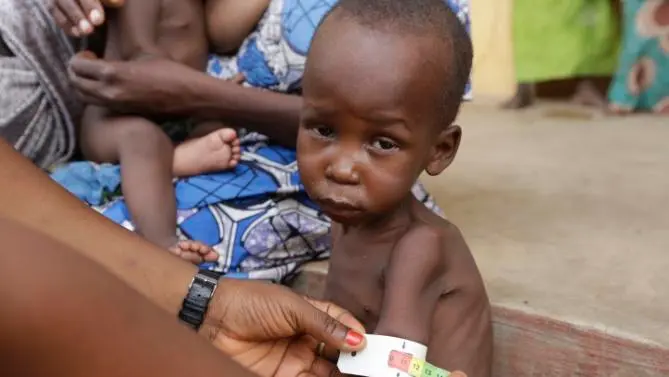
A new assessment by the Famine Early Warning Systems Network, an early warning agency funded by the United States Government, reveals that acute hunger will continue to afflict Nigeria, with an estimated 16 million to 16.99 million people requiring urgent food assistance by January 2027.
Although this figure represents a seasonal decline from the 20 million to 20.99 million individuals needing aid in July 2026, FEWS NET warns that the country’s underlying food crisis continues to deepen.
The projected numbers for early 2027 remain higher than those recorded in January of last year and exceed Nigeria’s five-year historical average.
Nigeria ranks among the most affected nations globally.
By January 2027, the country is projected to hold the fourth-largest population facing severe hunger worldwide, trailing Sudan, Pakistan, and the Democratic Republic of Congo. Currently, in mid-2026, Nigeria carries the second-highest burden globally, behind Sudan. Along with Sudan, Pakistan, and the DRC, Nigeria is one of only four nations expected to contribute more than 10 percent each to the estimated 145 million to 155 million people requiring food assistance globally across the 30 countries monitored by FEWS NET.
The report identifies persistent conflict, economic hardship, climate disruptions, and restricted access to farmland as the primary drivers of Nigeria’s food crisis, particularly in the northern regions.
While the main harvest concluding in December will provide temporary relief, ongoing insecurity prevents many agricultural households from cultivating their fields.
Regarding the harvest’s limited impact, the report noted: “Despite the completion of the main harvest in December, staple food prices are expected to remain high as production and supply disruptions coincide with high market reliance among conflict-affected households who are unable to cultivate,”
Because of these disruptions, heavily affected areas in the North-East are expected to remain in the Emergency phase of food insecurity, designated as IPC Phase 4.
Under this level, the final stage before famine, families face severe food consumption deficits, leading to high rates of acute malnutrition and mortality, or survive only by liquidating vital assets such as farmland and livestock.
On a global scale, FEWS NET highlighted that five countries risk slipping into full-blown famine: Sudan, South Sudan, Somalia, Mali, and Chad. Meanwhile, South Sudan has the highest proportion of its population in need of food assistance, affecting between 50 and 55 percent of its citizens.
FEWS NET explained that its estimates encompass populations enduring Crisis-level hunger or worse (IPC Phase 3 and above), alongside those who would reach those levels without sustained aid.
Unlike regions where data collection relies on remote monitoring, the findings for Nigeria were derived from direct, in-country analysis.


