


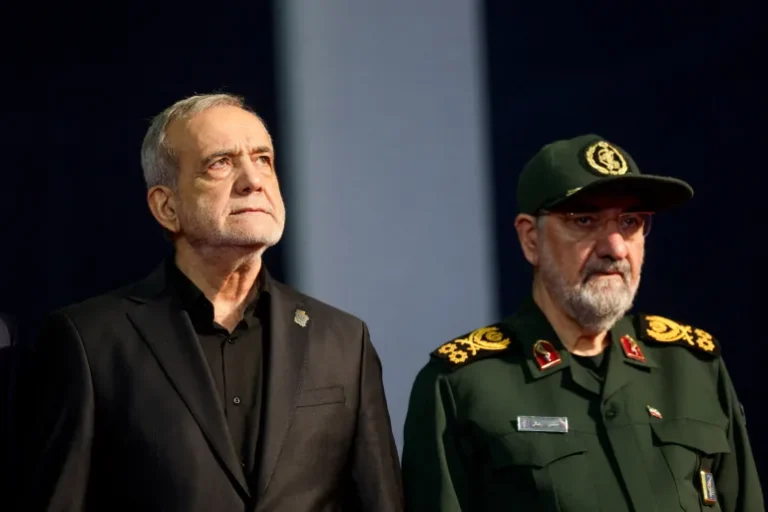
Iranian President Masoud Pezeshkian has advocated for concluding the months-long conflict with the United States, asserting that Tehran is acting from a stand of strength despite stalled diplomatic discussions.
“It is better that we bring the war to an end now as we are in a position of power and dignity,” Pezeshkian said in a meeting with doctors on Friday. “The whole world acknowledges our victory and emphasises that America has attacked our schools, hospitals and infrastructure in violation of all regulations and is hated around the world.”
Pezeshkian – whose presidential powers remain subordinate to Iran’s Supreme Leader Mojtaba Khamenei – defended the June memorandum of understanding reached with Washington against opposition from hardline lawmakers who claimed the administration conceded too much.
“They cannot find even a single clause in this agreement that indicates capitulation. All the commitments concern the other side,” he said.
Following the expiration of the memorandum of understanding, Iran’s military leaders emphasized that their forces remain prepared to counter potential actions.
“With preparedness across land, sea, air, air defence and cyberspace, Iran’s armed forces will respond to the enemy’s new threats with crushing, punishing and devastating responses,” Major-General Ali Abdollahi, chief of staff of Iran’s armed forces, was quoted as saying by Iranian media.
Concurrently, the foreign ministers of Oman and Iran spoke via telephone on Friday to evaluate options for renewing diplomatic dialogue and to review conditions surrounding maritime navigation in the Strait of Hormuz, state media in Oman reported.
Tehran continues its partial closure of the key transit passage, while Washington maintains a naval counterblockade. American media reports suggest the US Navy has organized and escorted private tanker convoys through the southern area of the strait, allowing between five and 10 million barrels of crude oil per day to pass.
In Washington, President Donald Trump expressed doubt regarding Tehran’s commitment to reaching an agreement. Addressing journalists on whether American military choices were constrained, Trump remarked: “It just means that we’re seeing what happens.”
“We have total control of that entire region having to do with the Strait of Hormuz, and that means well into it, the land areas. So, they would love to make a deal, but they’re not ready to make the right deal, in my opinion,” Trump added.
Trump further cautioned that economic penalties would be directed at any country offering “any type of lifeline to Iran.”
These statements coincide with warnings from US Treasury Secretary Scott Bessent that Washington intends to “collapse” the Iranian government through targeted economic penalties.
Bessent is scheduled to host a press briefing at the Department of the Treasury on Monday to outline new sanctions, signaling a focus on economic strategy by the Trump administration as the conflict reaches six months.
Iran’s Ministry of Foreign Affairs condemned the upcoming US policies, labeling them “economic terrorism” and stating that “the instigators of these sanctions are deserving of trial and punishment.”
China’s Ministry of Foreign Affairs spokesman Lin Jian also expressed opposition to the US sanctions strategy, noting that “sanctions and pressure will not help resolve the issue” and urging all parties to “take responsible measures and resolve the problem through political and diplomatic means.”


