


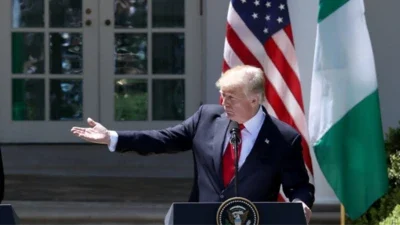
Nigeria is among the countries affected by a fresh wave of US tariffs on 60 trading partners that took effect on Friday, replacing an expiring global duty earlier imposed by President Donald Trump.
The new levies range from 10 to 12.5 per cent and affect major economies including China, India and the European Union, drawing protests from Beijing and other targeted nations. US Trade Representative Jamieson Greer said the measures were tied to enforcement of forced labour import bans, noting Washington has maintained such a ban for nearly a century and expects trading partners to follow suit.
The move follows the US Supreme Court’s ruling in February striking down a previous set of Trump tariffs, which had forced the administration to rely on alternative authority to impose a temporary 10 per cent tariff that expired on Friday. The new duties, first proposed in June after a months-long investigation, are considered more resistant to legal challenge.
Countries with forced labour import prohibitions in place or committed to adopting one — including Canada, the EU, India and the UK — face the lower 10 per cent rate, while China, Japan, South Korea and others face 12.5 per cent.
The EU, Taiwan, Japan, South Korea and Switzerland received partial relief under existing trade agreements with the US.Japan said it “regrets” the tariffs, Australia’s trade minister called them “unjustified,” and China said it opposes “all forms of unilateral tariff measures.”
The EU said the new rates align with its prior joint statement with Washington. Goods already under sector-specific tariffs, along with certain energy products, fertilisers and USMCA-covered goods, are exempt.
Washington is separately investigating 16 economies over excess industrial capacity, a process that could lead to further duties. Trade lawyer Greta Peisch said the strategy preserves US leverage over trading partners, while analyst Josh Lipsky said the approach signals a more durable, protectionist trade posture for the remainder of Trump’s term.


