



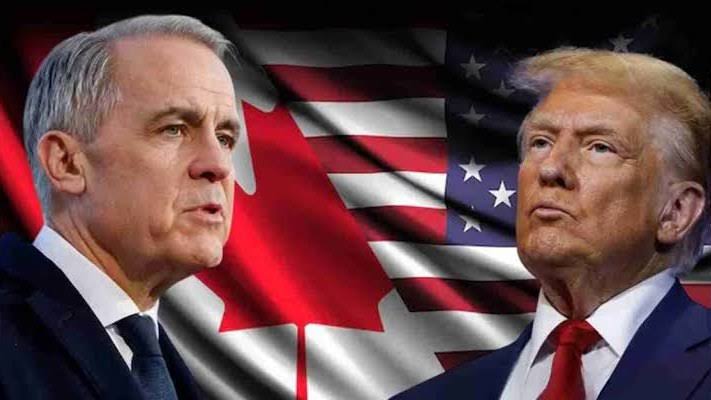
Canada revealed new counter-tariffs on US goods ranging between 15 and 50 percent on Tuesday, marking a sharp escalation in the trade dispute between the two long-standing allies.
The retaliatory measures from Ottawa will take effect on September 8, matching the schedule previously outlined by Prime Minister Mark Carney following US President Donald Trump’s implementation of 50 percent duties on Saturday.
Canadian officials confirmed Tuesday that the counter-tariffs correspond directly to US tariff levels, impacting key sectors such as steel, dairy, and consumer electronics.
The target list spans frozen and fresh fish, household appliances like dishwashers and washing machines, and industrial equipment including railway construction components.
Alongside the tariffs, the Canadian government unveiled a CA$7.5 billion ($5.4 billion) aid package designed to cushion affected businesses and workers.
“This is an unprecedented challenge imposed on Canada. But Canada will meet the moment,” Finance Minister Francois-Philippe Champagne said.
“I think what Canadians can see this morning is that we stand united,” he added. “Canada must respond, and today we are, in a proportionate, targeted and strategic way.”
Industry Minister Melanie Joly also urged Canadians to patronize domestic firms while promising to forge partnerships with new international allies. She additionally pledged to “fight back” should Trump carry out threats to raise US duties on Canadian automobiles to 50 percent.
The initial US tariff hike hit roughly $20 billion worth of Canadian products—representing about 5.5 percent of the country’s exports to the US—after last-minute trade talks broke down.
Under Canada’s new framework, US steel and aluminum imports previously taxed at 25 percent will now face 50 percent tariffs. A 25 percent levy will apply to appliances, dairy items such as cheese, and select steel and aluminum derivative products, while a 15 percent duty will cover electrical equipment and tools.
Altogether, these impacted items represent about 7.3 percent of Canada’s total imports from the United States based on 2024 trade volumes.
Market analysts warn that the situation could trigger further retaliatory cycles. Trump hinted on Monday at doubling tariffs on Canadian autos with non-US content to 50 percent starting next year, up from the current 25 percent rate.
Ontario Premier Doug Ford criticized the threat, remarking that Trump could “kiss my ass” and floating the idea of an electricity export surcharge.
Trump lashed out at Ford, warning of “far worse” consequences, while also referring to Carney as a “governor” to revive his controversial suggestion that Canada become the 51st US state. Continuing the hostile rhetoric, Trump stated Tuesday that he was considering renaming Lake Ontario to “Lake America,” mirroring his decision last year regarding the Gulf of Mexico.
The latest US tariffs contain no exceptions for goods protected under the US-Mexico-Canada free trade agreement (USMCA). Oxford Economics estimates these policies push the effective US tariff rate on Canadian exports to 6.9 percent from 5.1 percent, with plastics, electrical machinery, wood, and paper products driving the surge.
“Manufacturers in Quebec, New Brunswick, and Ontario will be affected the most,” Oxford Economics noted.
Over the weekend, Carney explained that US negotiators demanded late stage restrictions on Canada’s ability to pursue trade agreements with other nations. He noted that US officials made unacceptable “threats” to the French language and “Quebec culture.”
Trump denied those assertions Tuesday on Truth Social, stating he would “never interfere with Canadians speaking French” and accusing Carney of lying to “gain political support.”
The United States remains Canada’s premier trade partner, receiving 70 percent of total Canadian exports, while Canada stands as the second-largest goods trading partner to the US this year behind Mexico.
Polling data published Sunday by the Angus Reid Institute shows that while Canadians largely support Carney’s decision to walk away from negotiations, concerns over potential economic fallout remain widespread.
The White House previously cited alleged “discriminatory treatment” of American alcohol, automotive, and dairy exports by Canada as the rationale for the duties. Although implementation was briefly paused by Trump, multi-day discussions failed to yield an agreement.


