



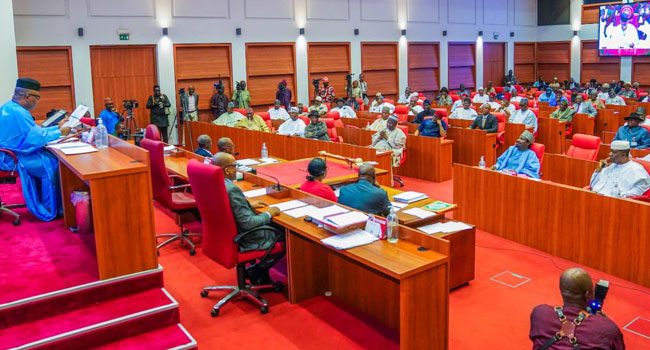
The Senate yesterday passed the Constitution of the Federal Republic of Nigeria (Alteration) (State Police) Bill, 2026, paving the way for one of Nigeria’s most significant security reforms since 1999 — while ensuring the Federal Government retains sweeping emergency powers over state policing.
If endorsed by at least 24 state Houses of Assembly, the bill will create a constitutional framework for State Police Services, alongside a strong Federal Police Service empowered to intervene under clearly defined circumstances.
Lawmakers suspended some procedural rules to fast-track the bill’s second and third readings within hours. Under the legislation, states will be empowered to establish and fund their own police services, recruit personnel and tackle local security challenges, subject to national minimum standards set by the National Assembly. The existing Nigeria Police Force will be replaced with a Federal Police Service, creating a dual policing structure operating alongside state police.
No state can begin operational policing until its Assembly passes enabling legislation and its police service is certified to meet national standards. State Police Service Commissions will handle recruitment, promotion and discipline, while a reconstituted National Police Council will coordinate federal-state cooperation.
State Commissioners of Police will now be appointed by governors on the recommendation of the National Police Council — a departure from the current system where the Inspector-General handles deployment. Their removal will require approval from the State House of Assembly.
The bill includes safeguards allowing the Federal Police Service to intervene during a breakdown of public order, threats to national security, administrative incapacity, or evidence of partisan or sectional misuse of state police. Such intervention — including temporary command of a state police service — would require presidential authorisation, Senate oversight and judicial review.
The Federal Police Service retains exclusive responsibility for terrorism, cybercrime, organised crime, arms trafficking, border security and inter-state crimes, while state police will handle local law enforcement and public order.
Governors of Ondo, Ogun and Kaduna states observed proceedings, alongside the President’s Chief of Staff, Femi Gbajabiamila, and attorneys-general from several states. Their presence sparked initial resistance from some senators who argued the chamber should be restricted to members, before Senate President Godswill Akpabio and Senate Leader Opeyemi Bamidele intervened.
Bamidele told colleagues the bill could not succeed without buy-in from state legislatures: “Without two-thirds of the State Houses of Assembly, whatever we are doing today will be in futility.”


