


Nigerian filmmaker urges diaspora to move beyond goodwill, become witnesses to Africa’s untold stories
For Precious Osuji, there exists a mission that is deeply personal, born from loss, shaped by responsibility, and fueled by an unshakable belief that the global African diaspora must become more than observers of the continent’s future…we must become the living architects of it.
Today, through diaspora engagement, humanitarian advocacy, and a growing commitment to strengthening Africa’s creative and economic ecosystems, Osuji is building bridges between global influence and local impact.
And on this journey, one of her first calls was to Michael Chineme Ike, the acclaimed filmmaker, girl-child advocate, and CEO of Flow With Pride Impact Hub in Abuja, whose work has become a powerful force in Nigeria’s menstrual health movement.
What followed was not simply an interview, but a deeply necessary conversation about responsibility, storytelling, womanhood, and what it truly means for the diaspora to come home with purpose.
Filmmaker and girl-child Advocate Michael Chineme ike Calls on Diaspora to Move Beyond Goodwill and Become Witnesses to Africa’s Untold Stories “The most powerful shift happens when a returning diaspora person stops being a visitor and starts being accountable”.
Highly celebrated Nigerian documentary filmmaker and menstrual health advocate, Michael Chineme ike, has issued a compelling call to Africans in the diaspora to move beyond symbolic gestures and embrace a deeper, sustained responsibility to the continent, one rooted not in grand announcements, but in consistency, witness, and genuine accountability.
Speaking in a wide-ranging interview, Chineme ike, whose documentary, Flow With Pride has become a landmark in Nigeria’s menstrual health advocacy space offered candid and thought-provoking reflections on diaspora identity, the power of storytelling, women’s development, and what long-term impact truly looks like.
The Diaspora Is Reshaping Africa’s Narrative, But Not Always IntentionallyOn the question of whether the diaspora is consciously reshaping how Africa is perceived, Chineme Ike was characteristically direct. He acknowledged that the reshaping is real, but argued that intentionality is rarely the starting point.
“Most people who return or reconnect with home are not thinking ‘I am here to change the story,'” he said. “They are thinking about their family, their business, their roots. The intentionality comes later, if it comes at all.
“For Chineme Ike, the turning point arrived during a filming trip to an IDP camp in Adamawa State, where he encountered girls who had never been told that menstruation is normal. “Those girls were not in any story being told about Africa,” he recalled.
“They were invisible, not because their lives were not significant, but because nobody had pointed a lens at them and said: you matter enough to document.
“He argued that the diaspora’s greatest advantage is not money or skills, but belonging. “We carry the culture in our bodies. We can walk into a room and be trusted in a way that an outsider never can. That is an enormous creative and political power, and most of us have not fully reckoned with what it means.
“Participation Becomes Responsibility the Moment You SeeWhen I asked Michael, “at what point participation transforms into responsibility, and how can ordinary individuals begin to engage in ways that create lasting impact?” Michael rejected the notion that change requires grand gestures.
His most lasting work, he noted, began with a low-budget documentary driven by stubbornness rather than resources.”Participation becomes responsibility the moment you see something that is wrong and you have the capacity, even a small capacity… to do something about it,” he said. “You cannot unsee a girl using sand as a sanitary pad. Once you know, silence becomes a choice.”His message to ordinary individuals was equally grounding.
Rather than asking “what can I do?”, he urged people to ask “what do I already have?” …a voice, a network, a profession, a platform of fifty followers or five thousand. “Every single one of those is a tool,” he said, pointing to the diaspora woman who uses her Instagram to discuss period poverty, or the one who connects a young Abuja NGO with a journalist in the United States.
“That is how these changes happen.”Women Are Not a Special Interest Group. They Are the Infrastructure.On the critical importance of investing in women for Africa’s long-term development, Michael was unambiguous. “Women are not a special interest group.
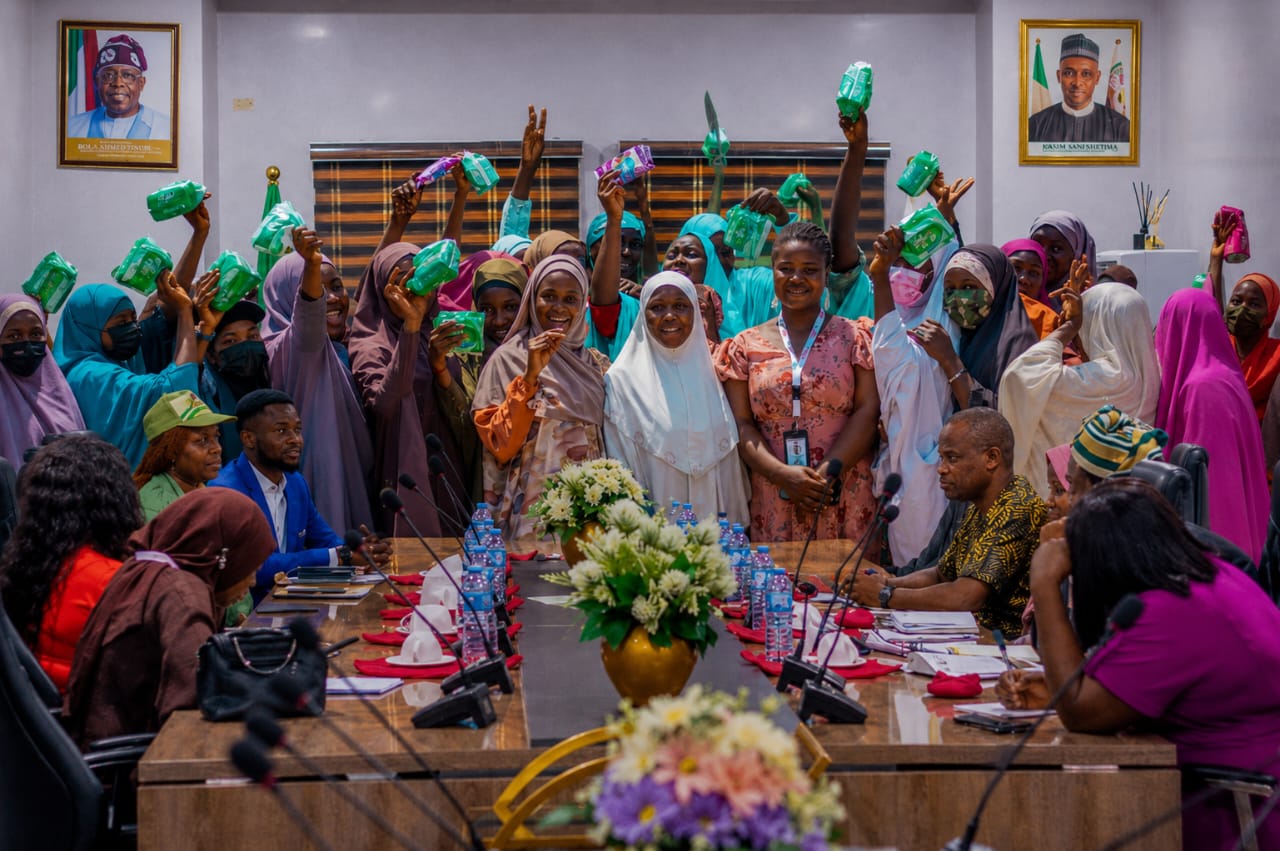
They are the infrastructure,” he stated…a declaration he grounded not in rhetoric but in lived observation. Describing the impact of the Flow With Pride documentary screening in Abuja, he noted that government ministers in the room were moved not just professionally, but personally.
“What we were showing them was not just a health crisis. It was an education crisis, an economic crisis, and a generational crisis all wearing the same face. “He broke down the compounding effect with stark clarity: a girl who misses four days of school every month across twelve years of education does not merely fall behind academically, she falls out of the story entirely, becoming less likely to finish school, earn income, or make autonomous decisions about her own life.
“And then her daughter inherits the same conditions, and the cycle tightens.”The biggest gap, he argued, lies not in vision but in political will. “Nigeria has a National Policy on Menstrual Health. We have gender equality frameworks. We have beautifully worded commitments.
But in the schools we have visited, girls are still using rags. Still missing school.” This reality, he said, is precisely why his organization – FWPIH, is pushing for the Menstrual Health and Hygiene Act. “A policy can be quietly shelved. A law is much harder to ignore.
“What Long-Term, Impact-Driven Support Actually Looks LikeAddressing diaspora women who feel connected to home but struggle to translate that connection into meaningful contribution, Michael offered an answer both simple and demanding: consistency.
“There is no shortage of goodwill,” he said. “What is in shorter supply is the kind of sustained, unglamorous, keep-showing-up engagement that actually moves things forward. One donation does not change a system.
One visit does not build a movement.”He described what real long-term support looks like in practical terms, being the person a small organization can call for a connection, using professional networks to open doors, mentoring young women doing ground-level work, and amplifying causes consistently, even when the post will not go viral.
He also highlighted a unique and underutilized tool available to diaspora women…credibility.
“Many of us who are building here in Nigeria are fighting to be taken seriously by institutions that respect a certain kind of external validation,” he explained.
A diaspora woman who lends her title, address, and network to endorse local work “can open doors that no amount of local advocacy will open as quickly.
“Reflecting on the women who have made the greatest difference to FWPIH, Michael noted that they were not always the biggest donors. “They are the ones who showed up twice. Who remembered us when they did not have to. Who treated our mission as their own, even from thousands of miles away.
That kind of solidarity is a relationship, not a transaction. And relationships are what sustain movements long after the events are over and the photographs have faded.
“Michael Chineme Ike is a Nigerian Filmmaker and Co-Founder of Flow With Pride Impact Hub, an organization dedicated to advancing Menstrual Health and Hygiene in Nigeria.