

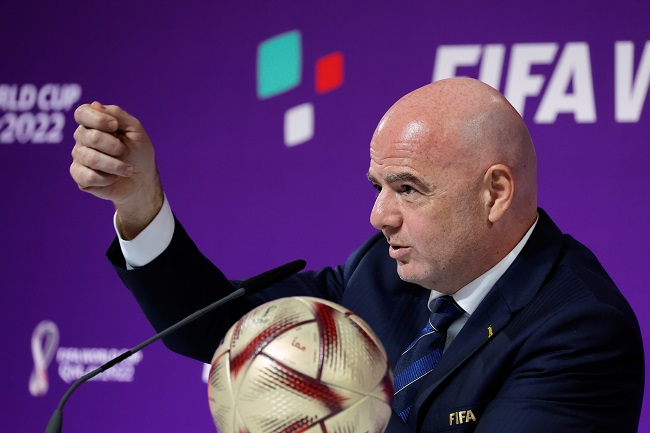
Facing widespread opposition from across the football world, FIFA President Gianni Infantino has officially abandoned plans to sell stakes in the governing body’s premier competitions.
Infantino explained that the initiative had created divisions that were no longer in the interest of its core goals. The Swiss executive confirmed the reversal by stating that, as a result, this proposal will not proceed.
Under the original arrangement, Infantino had promised each of the 211 member associations $40m (£30m) in exchange for supporting private investment in major tournaments, including both the men’s and women’s World Cups.
Welcoming the decision to drop the plan, Asian Football Confederation (AFC) President Shaikh Salman bin Ebrahim Al Khalifa stressed that the future of global football must always be shaped through proper consultation, collective dialogue and respect for the established governance structures of our game.
The collapse of the proposal follows intense resistance. On Thursday, European football’s governing body, UEFA, voted among its 55 member nations to boycott future World Cups if the deal went through.
Internally, FIFA COO Kevin Lamour revealed that the administration felt deceived regarding the initiative. Meanwhile, Infantino’s senior adviser on global strategy and governance, Carlos Cordeiro, stepped down from his position, labeling the scheme a bad deal for football that would mortgage football’s future.
Resistance continued to build across other continents. Concacaf rejected the proposal, with sources indicating that most member nations in North, Central America, and the Caribbean had lost confidence in Infantino. The AFC voiced solidarity with both UEFA and Concacaf, while UK Prime Minister Andy Burnham publicly declared Infantino to be the wrong man to guide FIFA.
This high-profile collapse places the 56-year-old FIFA president under heavy scrutiny as he prepares to run for a fourth term at the FIFA Congress in March. Moving forward, Infantino expressed a desire to bring all interested parties back together in the spirit of shared interest.
Though FIFA initially defended the scheme on Friday by claiming nobody is selling football, the reality of the voting numbers forced a retreat. Passing the proposal required approval from a simple majority of 106 out of 211 member associations. Once the AFC united with UEFA and Concacaf, opposition reached 136 votes, making passage virtually impossible.
Elsewhere, the African (CAF) and Oceanian (OFC) confederations scheduled discussions on the plan for August. South American governing body Conmebol opted to request additional information and clarifications concerning the scope, structure, governance and possible effects of the strategy.
The framework of the scrapped initiative centered on creating a commercial subsidiary named FIFA Forward Enterprise (FFE) to oversee major tournaments. FIFA intended to invite third parties to make minority, non-controlling investments in FFE. Federations were given a deadline of 19 September to approve the project in order to unlock an upfront payment of $20m (£15m).
A 25-page document prepared by investment bank JP Morgan outlined how payouts to federations could reach 24m euros (£20.5m) during the 2035-2039 cycle. The dossier cited new business initiatives and attracting top talent with incentive-driven compensation as growth drivers, describing the World Cup as the most widely viewed sporting event while characterizing FIFA as under-monetised.
The document contained no references to women’s football.
American venture capital firm Thrive Eternal, founded by Joshua Kushner, was expected to head the investor group for FFE. Addressing the situation on Friday, US President Donald Trump noted that he had not discussed the matter with Infantino, despite the two maintaining a close relationship since Trump re-took office in 2025.
