

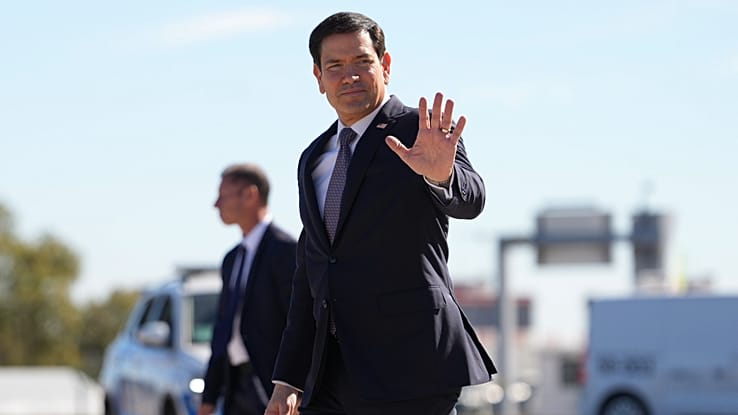
United States Secretary of State Marco Rubio has urged for de-escalation in the Horn of Africa following recent clashes in northern Ethiopia and rising strains with nearby Eritrea.
During a telephone conversation on Wednesday with Ethiopian Prime Minister Abiy Ahmed, Rubio encouraged dialogue guided by the 2018 peace accord signed between Ethiopia and Eritrea. A statement released by the State Department noted that Rubio emphasized the region cannot endure further conflict.
The flare-up in northern Ethiopia’s Tigray region over recent weeks has effectively undermined the 2022 peace agreement that brought an end to a devastating two-year war. Ethiopian officials have accused Eritrean forces of occupying portions of its land, whereas Eritrea denounced Ethiopia over what it described as a declaration of war.
Human Rights Watch has gathered accounts of non-combatants being killed and wounded by shelling in southern Tigray, Laetitia Bader, the organization’s deputy director for Africa, shared during an interview with The Associated Press on Tuesday.
Bader explained that artillery fire had also compelled several medical facilities to shut down, and she advocated for independent monitoring, the restoration of communications, and secure passage for humanitarian aid. Her statement did not specify which party was responsible for the shelling.
In a letter sent to the UN Security Council on Friday, Ethiopian Foreign Minister Gedion Timothewos claimed that Eritrea had positioned forces across the border and stated that Ethiopia was carrying out actions in self-defense. He did not elaborate on those actions, specify the occupied territories, or present evidence backing the claims. The AP was unable to independently verify these assertions.
Eritrean Foreign Minister Osman Saleh called on the Security Council to denounce what he termed a “deplorable declaration of war” by Ethiopia. His reply neither confirmed nor denied the reported troop incursions.
An international security source informed AFP last week that an estimated 5,000 to 8,000 Eritrean troops are currently located inside Tigray.
In his conversation with Abiy, Rubio stressed that “all countries in the Horn of Africa must respect the sovereignty and territorial integrity of their neighbors and avoid cross-border incursions.”
The friction also highlights ongoing disputes regarding Abiy’s attempts to secure access to the Red Sea. Ethiopia became landlocked following Eritrea’s independence in 1993.
Military forces from both nations previously fought side by side against the Tigray People’s Liberation Front during the 2020–2022 conflict, which resulted in roughly 500,000 civilian fatalities due to violence, starvation, and the breakdown of healthcare systems, according to research from Ghent University in Belgium.
Last week, fighters allied with the government entered Mekelle, the regional capital of Tigray, after the rebel Tigray People’s Liberation Front announced its retreat. Ethiopian Airlines subsequently restarted flights to Mekelle on Sunday after grounding all air travel to the area for several days.
