

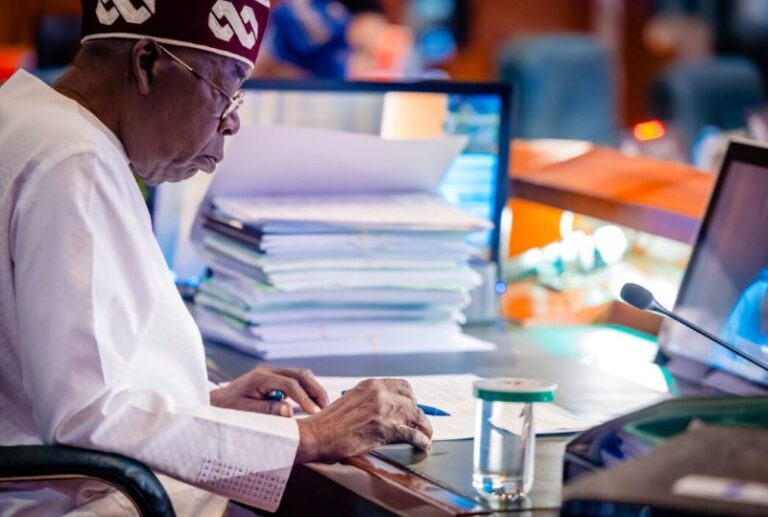
President Bola Ahmed Tinubu has formally written to the Senate to stop the consideration of his earlier October 26 request seeking approval for a $20.52 billion and €1.045 billion loan. In its place, the President has presented a scaled-down external borrowing proposal of $7.7 billion aimed at bridging part of the 2026 budget deficit.
The adjustment was disclosed during Wednesday’s Senate plenary when Senate President Godswill Akpabio read an October 29 letter from the President. Akpabio informed lawmakers that the updated submission officially supersedes and cancels the previous foreign credit request.
The newly proposed $7.7 billion loan is a component of the N29.2 trillion total borrowing framework authorized under the 2026 Appropriation Act to fund an estimated N31.4 trillion budget deficit. Out of this total deficit funding, the executive plans to raise N10.79 trillion externally, while sourcing the remaining N18.4 trillion from domestic channels.
President Tinubu outlined that the external funds will be secured using a mixture of debt instruments, such as Eurobonds, bilateral and multilateral loans, International Monetary Fund facilities, and temporary bridge financing. However, he noted that the government will prioritize Eurobond issuance due to its speed and potential cost-efficiencies.
The President said: “All the options will be pursued simultaneously, considering the costs and related benefits to the country and the time required to access the funds.”
“In view of this, emphasis will be on the issuance of Eurobonds, which is typically faster to conclude. Additionally, a large amount can be raised through Eurobonds at a relatively lower cost.”
Tinubu explained that specific terms and conditions for the credit lines will depend on international market conditions at the time of execution. He assured the upper legislative chamber that the Federal Ministry of Finance and the Debt Management Office (DMO) will collaborate to negotiate the most advantageous terms for Nigeria.
The President highlighted that the fresh funds will be directed toward key infrastructure and developmental programs provided for in the 2026 budget, targeting priority areas including security, transport, agriculture, power, education, and healthcare.
“The new external borrowings are required to implement the items, programmes and projects in the 2026 Appropriation Act, which are designed to consolidate and strengthen the macroeconomic reforms and gains recorded by this administration in the past few years,” he said.
Furthermore, President Tinubu emphasized that fetching capital from external sources will bolster national economic stability and build up foreign currency reserves, as foreign capital injections will be routed directly through the central bank.
“It is also important to add that the process will increase the accretion to the external reserves, since the funds will be received by the Central Bank of Nigeria on behalf of the Federal Government, thereby supporting the naira exchange rate,” Tinubu stated.
The legislative request was submitted pursuant to Sections 21(1) and 27(1) of the Debt Management Office (Establishment, etc.) Act, 2003, which stipulate that external borrowings and their operational terms must receive approval from the National Assembly. In his letter, the President requested that the Senate authorize the Ministry of Finance and the DMO to initiate the necessary steps to execute the borrowing plan.
