

The Independent National Electoral Commission has launched a cleanup of its preliminary Register of Voters following the discovery of records featuring suspected AI-generated images and other discrepancies.
Speaking on Channels Television’s Sunday Politics, the commission’s Director of Information and Communication Technology, Lawrence Bayode, revealed that the Automated Biometric Identification System had flagged 268 records for review.
“What we are currently doing now is looking at all these 268 records that ABIS already flagged as AI-generated or even something of irregularities,” he said.
Bayode noted that certain individuals allegedly utilized their official credentials to construct invalid profiles by exploiting a special registration option intended for persons with disabilities who lack full or any fingers. He pointed out that this option was abused to mislead the system, representing one of the major flaws picked up by ABIS.
He stated that the electoral body has already begun addressing the flagged entries.
“Those that we have seen, we are cleaning up,” Bayode said.
However, he clarified that not every picture modified using artificial intelligence would be deleted, drawing a line between fully synthetic AI images and authentic pictures enhanced via smartphone tools.
“Those that we know it is the AI on the phone that helped enhance their pictures, we can’t exclude such people because it was the AI on the phone that does that. Such people will still be on the register but those AI-generated, those photographs, all these will be removed. We are already looking at them,” he said.
The controversy arose after the online release of the preliminary Register of Voters on October 26, when screenshots began circulating across social media highlighting suspect photos attached to entries, notably from parts of Edo State. Additional concerns were raised over possible duplicate registrations and the inclusion of deceased individuals on the list.
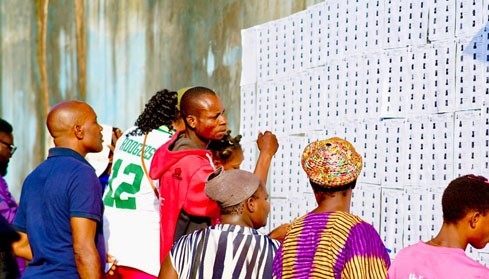
Addressing the public reaction, the commission stated that the online version matched the preliminary register displayed physically at Registration Areas nationwide between October 9 and October 15. It emphasized that the published list did not yet capture ongoing data-cleaning efforts.
Furthermore, the electoral body clarified that the list is not the final certified version and explained that the public display, claims, and objections period was specifically designed to allow citizens to identify errors and questionable entries prior to official certification.
The commission intends to finalize all required verification, adjudication, and data-scrubbing procedures before certifying the final Register of Voters on December 15, 2026.
