

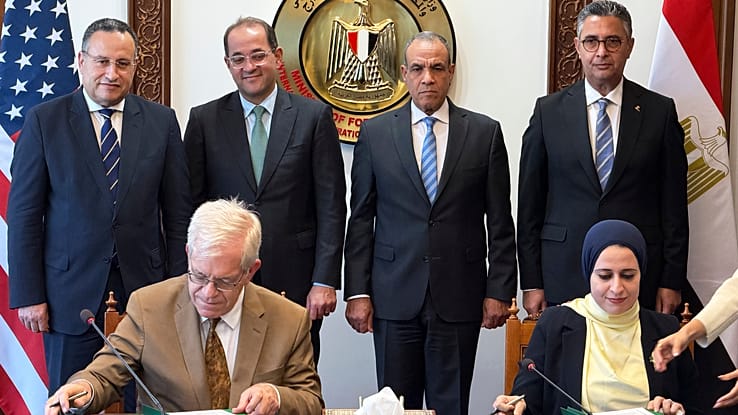
Egypt and the United States have officially entered into a strategic objectives framework agreement designed to drive shared economic progress.
The signing ceremony took place at the Foreign Ministry headquarters in Egypt’s New Administrative Capital, attended by Foreign Minister Dr. Badr Abdelatty, alongside the ministers of finance, supply and internal trade, and higher education and scientific research.
The deal was formally signed by Dr. Samar Al Ahdal, Deputy Foreign Minister for International Cooperation, representing Egypt, and Robert Silverman, Chargé d’Affaires at the US embassy, representing the United States.
Al Ahdal highlighted the long-term scope of the financial commitment following the signing.
“The total amount of the US contribution under the agreement amounts up to $625 million over a period of five years,” said Al Ahdal.
Silverman expressed optimism about the future of the partnership, noting that this initial round commits $125 million in grant funding and serves as the foundation for anticipated annual agreements.
“We hope this agreement will expand modernisation here, particularly in the high-tech sectors, and also to find new opportunities for private sector US investment in Egypt,” said Silverman.
Foreign Ministry spokesman Ambassador Nader Zaki emphasized that the primary goal of the agreement is delivering concrete economic results.
The framework is structured to introduce American technological and institutional innovations to upgrade Egypt’s water, energy, and infrastructure networks. Additionally, it targets the modernization of governance, healthcare, and education to train a skilled local workforce and generate employment opportunities.
Key focus areas under the initiative include water resource management, artificial intelligence, energy expansion, and enhancing food security through advanced agricultural science.
While the embassy has previously noted that US annual economic assistance to Egypt stands at $125 million delivered via USAID initiatives, this five-year $625 million package aligns directly with that established rate. This funding remains entirely separate from the approximately $1.3 billion in annual military aid the country has received from the US since 1979.
