

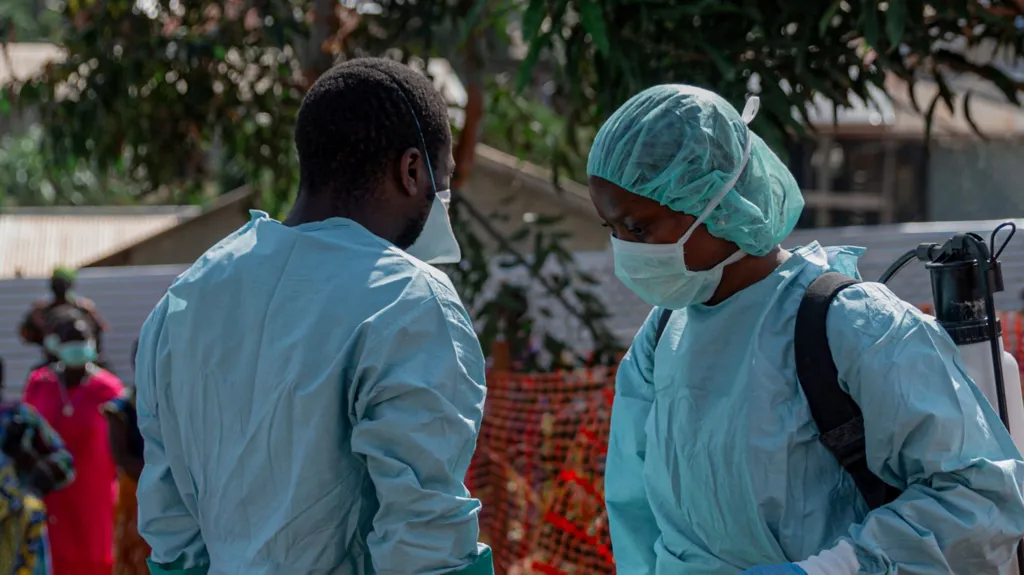
Health officials in the eastern Democratic Republic of Congo are urgently searching for a six-year-old girl and her mother after armed men raided the hospital where the child was undergoing treatment for Ebola.
According to a statement from local health official Dr. Lubambo Maboko Gaston, “very angry” men armed with knives seized the young patient from Wanamahika Hospital in the city of Butembo.
While it remains uncertain if the armed men were acquainted with the family, deep-seated fear and suspicion regarding Ebola treatment facilities have been widespread throughout this current outbreak.
In an interview with Reuters, Gaston made a direct plea, urging the mother and child to seek immediate medical attention because they risked “worsening their health” and “infecting their relatives”.
This incident is part of a broader pattern of hostility toward medical facilities during the active outbreak, which has already seen 840 confirmed cases and nearly 200 deaths. Just last month, law enforcement in the town of Mongbwalu had to fire warning shots into the air to disperse furious crowds attempting to seize the bodies of deceased relatives from a medical center.
Days prior to that event, another crowd set fire to isolation tents at a hospital in Rwampara, located 85 kilometers (53 miles) southeast of Mongbwalu—after being blocked from removing the body of a suspected Ebola victim.
Securing the remains of Ebola victims is a critical public health measure, as the bodies are highly contagious and traditional burial preparations can rapidly accelerate transmission.
“People are not properly informed or sensitised about what is happening.
For a certain segment of the population, especially in remote areas, Ebola is an invention by outsiders, it does not exist,” local politician Luc Malembe explained to the BBC last month. “They believe it is the NGOs and hospitals creating this to make money, and this is tragic.”
Exacerbating the crisis is the fact that this surge is driven by the rare Bundibugyo species of the virus, for which there is no existing vaccine. The World Health Organization has indicated that developing a viable shot could take several months.
The scale of the situation has raised international alarms. On Tuesday, Jean Kaseya, head of Africa’s Centres for Disease Control and Prevention (CDC), echoed previous warnings from the US CDC by stating that this crisis could become one of the largest on record.
“If we don’t stop the outbreak very soon it will be worse than what we had in West Africa and eastern DRC,” Kaseya warned during a summit with African heads of state and donors, referencing the 2018 DRC surge and the West African epidemic a decade ago that claimed over 11,000 lives across Guinea, Liberia, and Sierra Leone.
Speaking to Reuters, Kaseya added that a significant obstacle to containing the virus remains the failure to track down many individuals who have been exposed to infected patients, a process vital to stopping the chain of transmission.
