

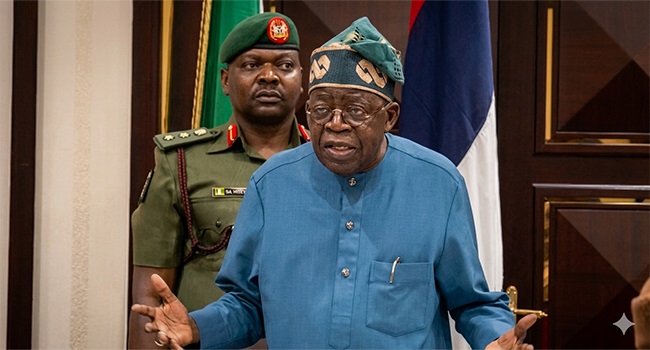
President Bola Tinubu has expressed strong confidence that Nigeria’s security trials, particularly in the northern states, will soon come to an end, assuring citizens that targeted measures have been put in motion to dismantle criminal networks nationwide.
Speaking on Saturday at the Third Late General Hassan Usman Katsina Memorial Conference in Kaduna, where he was represented by his Special Adviser on Political and Other Matters, Ibrahim Masari, the President shared his optimistic outlook for national safety.
During the event, Tinubu paid tribute to the late General Hassan Usman Katsina, a former military governor of the defunct Northern Region and Chief of Army Staff, praising him as a model of humility, discipline, patriotism, and selfless service.
He noted that the late military leader played a pivotal role in strengthening the nation during critical historical moments, emphasizing that his dedication to unity helped lay the groundwork for today’s democratic freedoms.
The President reaffirmed his administration’s drive to secure the nation while preserving the legacy of past leaders.
“While we continue to work day and night to secure our nation, by the grace of Allah, the challenges of insecurity confronting us, particularly in Northern Nigeria, will soon be behind us,” Tinubu said.
Turning to development, the President detailed a wide-ranging series of government programs covering education, infrastructure, transportation, and power, describing them as key elements of a strategy to improve lives and spur national growth.
In education, Tinubu revealed that the Nigerian Education Loan Fund (NELFUND) has assisted more than one million students in pursuing higher education.
He also noted that removing tertiary institutions from the Integrated Payroll and Personnel Information System (IPPIS) has boosted institutional autonomy and restored stability in public universities. Furthermore, funding from the Tertiary Education Trust Fund (TETFund) has supported new classrooms, laboratories, hostels, and research facilities.
Alongside these additions, the administration has introduced a revised national curriculum, expanded teacher development programs, established new federal universities and polytechnics, and increased investment in technical and vocational schooling.
On infrastructure, Tinubu reported steady progress on several key highways, including the Abuja–Kaduna–Zaria–Kano Expressway, the Sokoto–Badagry Super Highway, the Sokoto–Zamfara–Kaduna Road, and the Akwanga–Jos–Bauchi–Gombe Road, all designed to improve travel and commercial activity.
Addressing energy development, the President pointed to ongoing work on the Kaduna Power Station, the 40-megawatt Kumbotso High Voltage Power Project, and the revival of the 215-megawatt Kaduna Power Plant. To expand clean energy access, the government is installing over 1,500 solar streetlights and 50 rural mini-grids.
Additionally, the College of Petroleum and Energy Studies in Kaduna has been upgraded to a full university named after the late General Hassan Usman Katsina, with construction passing 90 percent completion and academic activities already underway. Progress is also continuing on the 1,350-megawatt Gwagwalada Independent Power Plant, aimed at boosting power supplies across Northern Nigeria and the Federal Capital Territory.
In transportation, work is moving forward on the Kaduna–Kano Rail Line and the Kano–Maradi Rail Project.
Funding has been secured for the Kaduna and Kano Light Rail initiatives, while upgrades to the Abuja Metro Rail and the Abuja–Kaduna train service are currently underway to ease the movement of commuters and goods.
Tinubu emphasized that these extensive developmental efforts reflect his administration’s firm commitment to restoring peace, fostering economic growth, and building lasting progress for all Nigerians.
