

Authorities in Spain and Morocco moved to strengthen border security around the Spanish enclave of Ceuta on Friday following an unprecedented arrival of tens of thousands of migrants by land and sea within a single day.
Official reports indicate that the increased enforcement has effectively halted the influx, which saw more than 49,000 people cross into the European territory located on the northern coast of Africa.
During a visit to the enclave on Friday, Spanish Prime Minister Pedro Sanchez strongly condemned the sudden wave of arrivals, calling it a violation of the nation’s territorial integrity.
“The Spanish government stands with the city of Ceuta. We understand the emotion and the state of anxiety they have been experiencing over the last few hours — especially today,” he said.
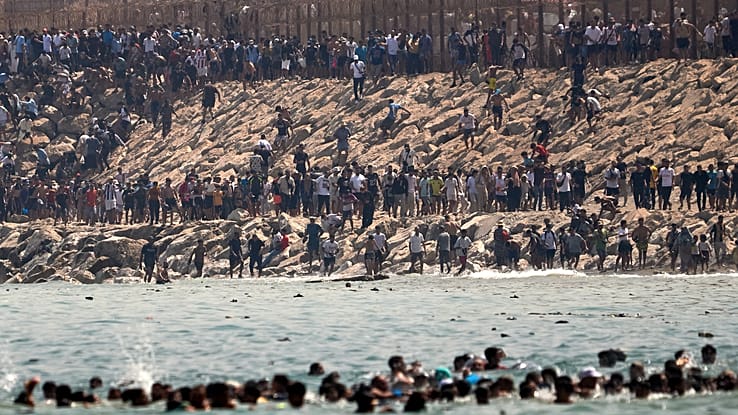
Video footage from the area captured individuals swimming around coastal barriers or scaling the border fences dividing the two nations to reach the enclave.
Following requests from local officials for federal assistance, military forces were deployed to restore order in the city. The regional governor confirmed that the casualty count has reached at least 34 deaths.
While some individuals drowned during the attempt, others lost their lives in a stampede near the breakwater fence along Tarajal beach, a public coastal spot situated close to a Moroccan border checkpoint.
A representative for a local Civil Guard officers’ association characterized the event as a severe humanitarian crisis.
In the aftermath, thousands of migrants, including unaccompanied minors, were left sleeping on sidewalks and in public parks, while many others wandered through the streets.
Among those searching the area was Ikraa Khai, a Moroccan agricultural worker from the Spanish town of Huelva, who traveled to the beach looking for her nephew.
“I don’t know if he is dead or alive. I have his residency card. But I don’t know where he is, I’m searching,” she said.
The exact trigger for the massive coordinated movement remains unclear. Spain frequently serves as a primary gateway into Europe for individuals seeking economic relief or fleeing violence in their home nations.
The head of Ceuta’s regional government, Juan Jesús Vivas, had previously cautioned on Wednesday that local reception centers were completely overwhelmed, leaving hundreds already sleeping outdoors.
Ceuta, situated on a historic isthmus, has been under Spanish rule since 1580. The enclave is home to a diverse population of Christians, Muslims, Spanish citizens, Moroccan residents, and daily cross-border workers who typically coexist peacefully.