



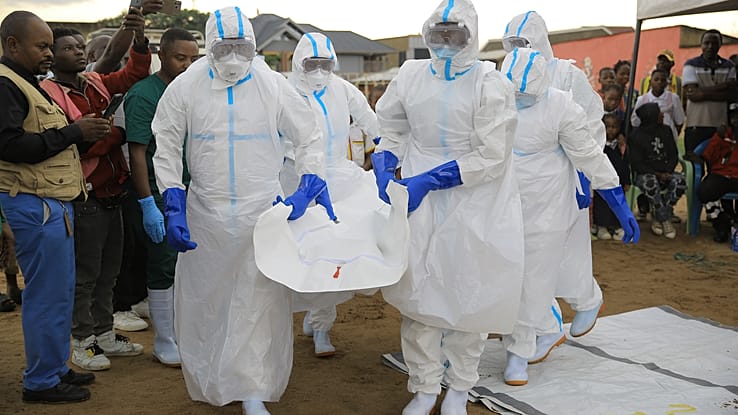
Victor Kingombe, a young doctor working in one of Congo’s newly impacted regions, passed away on Thursday at an Ebola treatment facility in Kisangani.
After his passing was confirmed, family members and fellow medical professionals assembled for his burial, observing from afar as health workers clad in complete personal protective equipment loaded his remains into a coffin.
“Our internal medicine doctor is gone. Doctor Victor, why? Why, Doctor? Our internal medicine doctor,” one of his colleagues, fellow doctor Agnes Kalokola cried.
Cases were first logged in Kisangani, Tshopo province’s main city, in late June. The specific facility where Kingombe passed away opened its doors under two weeks ago.
While infections have slowed down this month in Ituri province, the epicenter of the crisis, adjacent areas are witnessing sharp spikes.
In North Kivu, infections have jumped 73 percent over the last three weeks alone.
The virus is transmitting under severely challenging circumstances, exacerbated by violence, displacement, an ongoing strike by health professionals, and significant movement among local populations.
The World Health Organization warned that the current epidemic is pacing to overtake the 2014-2016 West Africa outbreak, which remains the deadliest recorded to date.
Medical personnel are additionally encountering deep-seated community skepticism, with care facilities and safe burial units suffering repeated attacks.
Misinformation has proliferated, causing many residents to doubt the existence of the virus.
Didier Lomoyo Iteku, Tshopo province’s vice-governor, was present at Kingombe’s burial and spoke to the public’s skepticism after viewing the physician’s body through a plastic barrier.
“This disease is real. Here is a doctor who was here trying to save lives, and he himself was a victim,” he said.
Health workers in Kisangani began receiving the Ervebo vaccine in August, a dose initially engineered for the Zaire strain of Ebola.
Researchers noted it provides a degree of immunity even though the current outbreak stems from the Bundibugyo strain. Clinical evaluations for targeted treatments against this rarer strain are currently taking place nationwide.


