


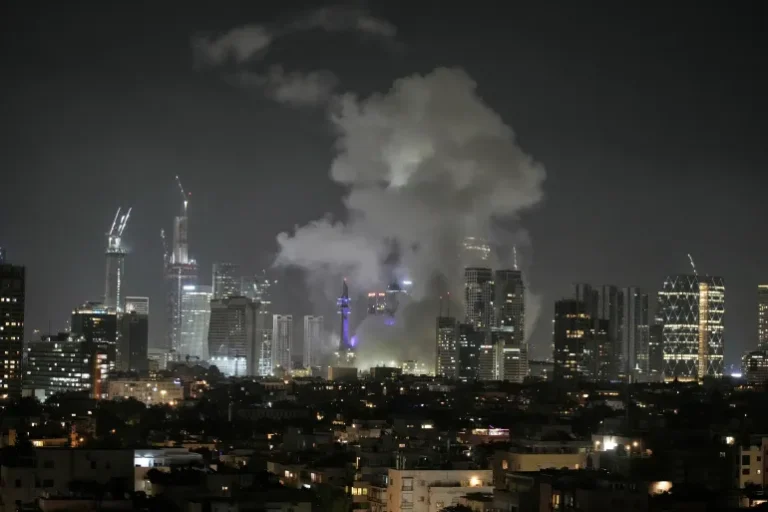
A relentless wave of military strikes by the United States across Iran has triggered fresh anxieties over a major escalation, marking the heaviest bombardment since a tentative agreement was reached between the two nations last month.
Over nearly a week of operations, American warships and fighter jets have targeted hundreds of military locations alongside several civilian sites.
Iranian officials have confirmed bombardments spanning at least 10 provinces, concentrated heavily in southern regions near the vital Strait of Hormuz.
While the capital city of Tehran has avoided recent strikes, allowing daily life for its 10 million residents to remain largely unchanged, the nation’s economy continues to struggle. The overall future looks highly volatile more than four months into the air campaign led by the US and Israel.
“Everything is too chaotic right now to guess what will happen next but it doesn’t look good,” said Farshad, a 21-year-old living in eastern Tehran.
“I just really hope all-out war doesn’t start again because I don’t have the nerve for daily bombing on top of everything else,” he told Al Jazeera.
The Islamic Revolutionary Guard Corps (IRGC) announced that the Strait of Hormuz is once again considered closed because of American military interference.
According to the IRGC, two ships attempting to navigate via the Western-supported southern route near Oman, instead of the northern path specified by Iran, were hit.
In retaliation for the bombardments, Iran claimed to have struck back at US assets across the Middle East, including targets in Bahrain, Jordan, Kuwait, Oman, and Qatar. With both sides dug in, the likelihood of diplomatic talks replacing military action appears low.
Nastaran, another resident of Tehran, expressed deep worry over the recent nighttime escalation.
“I didn’t expect it would be this bad when I picked up my phone this morning to check the news,” she noted. “I think there will be more attacks soon.”
Meanwhile, American forces continue to widen the scope of their operations.
US Central Command reported hitting over 300 military assets across three waves of strikes, focusing on drone, missile, and naval sites, alongside communications, logistics, and coastal surveillance hubs. The US military has not acknowledged hitting any civilian areas.
Mirroring previous flare-ups, heavy strikes bombarded Hormozgan province, targeting key locations like the major port city of Bandar Abbas, as well as Jask, Qeshm, and Siri along the strait.
The attacks heavily damaged air defenses, fishing hubs, ports, and coastal infrastructure, reportedly resulting in the death of a soldier and causing casualties among local fishermen.
US missiles also struck various sites within Bushehr province, including an impact near the outer perimeter of Iran’s sole nuclear power station, though no damage to the facility was reported.