



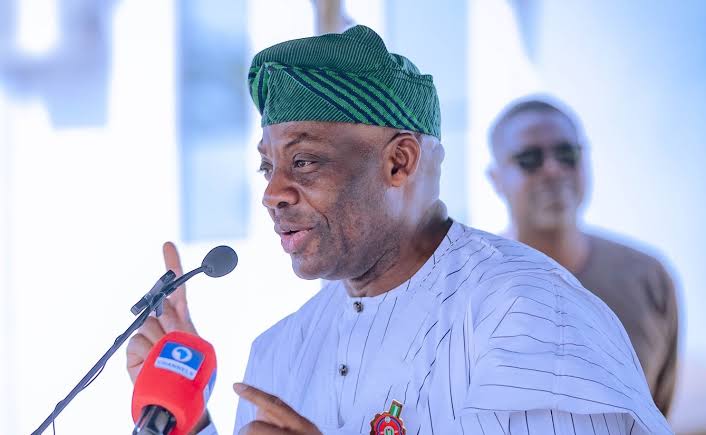
The Federal Government has begun reviewing its overseas scholarship and bilateral education arrangements as part of measures to curb unnecessary expenditure and redirect public funds toward strengthening Nigerian tertiary institutions, Minister of Education Dr Tunji Alausa has announced.
Alausa stated that the administration can no longer justify spending limited public funds on sending students abroad for academic programmes that are already offered by domestic universities, polytechnics, and colleges of education. He explained that the review aims to build local capacity while ensuring better value for government spending.
The minister cited a recent proposal involving approximately 100,000 Nigerian students designated to travel to Morocco for English-taught courses like mass communication and journalism. He noted that the plan raised concerns because the courses exist in Nigeria, and the candidates would have spent their first year learning French before starting their main studies.
“Number one, we have all those courses in Nigeria. And yet, number two, they were going to spend the first year learning French before they started the programme,” Alausa said.
He noted that the expense of funding those students overseas was indefensible given Nigeria’s expanded tertiary capacity, adding, “And number three, in the position of a few million to support this in Nigeria, we support thousands of them.”
The government ultimately deemed the previous arrangement an inefficient use of resources.
“So the Bilateral Education Agreement was not making sense, again, to us in government. It was a way to waste government funds,” Alausa said. “And this President will not waste any public funds.”
This decision reinforces the government’s stance to phase out government-funded Bilateral Education Agreement scholarships for new applicants while maintaining support for existing beneficiaries until they complete their studies. The policy is not a total ban on foreign scholarships, as international governments remain free to sponsor Nigerian students independently without state counterpart funding.
Addressing the shift in strategy, Alausa noted that the circumstances surrounding foreign scholarships have evolved over time.
“When those programmes were set up 20 years ago, they were meant to get students to go to the government colleges where we did not have capacity,” he said. “But in the last 20 years, we’ve built a number of capacities in the tertiary institutions — universities, polytechnics and colleges.”
The ongoing review aligns with wider Ministry of Education reforms under President Bola Ahmed Tinubu’s Renewed Hope Agenda, which focus on upgrading domestic institutions, modernizing technical and vocational education, expanding digital learning, and supporting research.
To offset the changes in foreign sponsorship, the administration is bolstering local financial support systems, including student bursaries and the Nigerian Education Loan Fund. Alausa emphasized that public funding must prioritize national needs, pointing to instances where beneficiaries designated for foreign scholarships ended up studying locally.
“So we have to start with Nigerians,” the minister said.
Additionally, Alausa recently inaugurated the Tertiary Institution National Gallery Prize Committee to support academic research with potential for commercial and industrial use.
“We want undergraduate researchers to see a clear pathway from academic research to industrial application, enterprise, innovation, and national development,” he stated.
He concluded that Nigeria must evaluate its educational success by practical outcomes rather than just paper qualifications.
“The most successful nations of the 21st century will not necessarily be those endowed with greater natural resources. They will be those that can systematically transform knowledge into solutions, research and intellectual capital into economic and industrial value,” Alausa said.


