

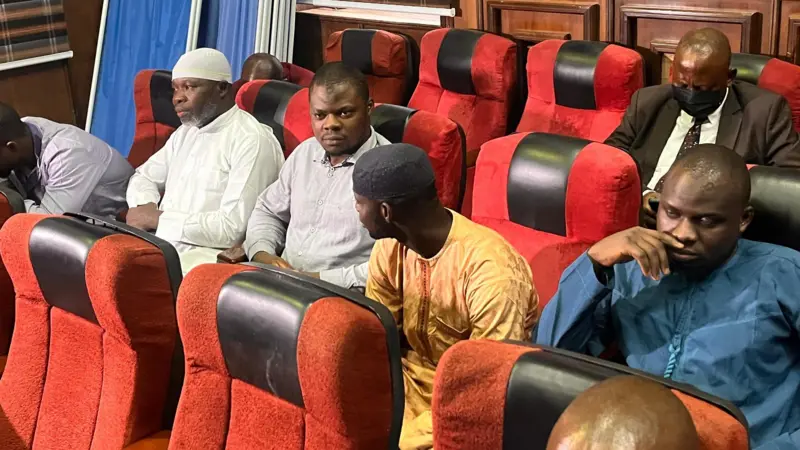
The Federal High Court in Abuja on Wednesday sentenced four members of the Al-Shabaab terrorist group to death by hanging for their roles in the devastating June 5, 2022, assault on St. Francis Catholic Church in Owo. The infamous attack resulted in the deaths of over 40 congregants and left more than 100 others wounded.
Presiding Judge Emeka Nwite delivered the verdict after finding Idris Abdulmalik Omeiza (25), Al Qasim Idris (20), Jamiu Abdulmalik (26), and Abdulhaleem Idris (25) guilty on a nine-count terrorism charge. The case was prosecuted by the Department of State Services on behalf of the Federal Government.
READ MORE: Tragedy as five kidnapped Kwara Church worshippers die in captivity despite ransom talks
Meanwhile, the court discharged and acquitted the fifth defendant, Momoh Otuho Abubakar (47), ruling that there was inadequate evidence to connect him to the horrific incident.
In his judgment, Justice Nwite maintained that the prosecution team successfully proved the guilt of the four individuals beyond a reasonable doubt. He emphasized that the evidence presented explicitly proved they were active participants and members of the terrorist organization behind the bloody massacre.
The court established that the convicted men were key operatives of an Al-Shabaab terrorist network running out of Kogi State, and that they directly executed the attack on the church during a festive Pentecost Sunday service.
According to the state’s case, the gunmen breached the sanctuary, trapped the helpless worshippers inside, and carried out a violent onslaught that caused immense casualties and widespread structural ruin. The prosecution detailed how the attackers deployed improvised explosive devices (IEDs) alongside AK-47 rifles to advance their radical extremist religious ideology.
To secure the conviction, the prosecution team presented 11 witnesses and submitted 23 pieces of evidence.
This included a digital forensic analysis report and confessional statements provided by the suspects. Among the physical evidence admitted was a mobile phone containing communication records sent between the defendants both before and after the massacre occurred.
One of the key prosecution witnesses, a Catholic priest who survived the ordeal, provided a chilling testimony of the event.
He detailed how the terrorists set off at least three explosives inside the building, triggering instant panic, heavy bloodshed, and absolute devastation among the families gathered for worship.
Justice Nwite concluded that the collective weight of the prosecution’s evidence irrefutably tied the four convicts to the crime scene, validating their conviction on every terrorism charge.
The landmark ruling concludes one of the most closely watched terrorism prosecutions in recent Nigerian history, following a tragedy that deeply shocked the international community and drew fierce global condemnation.
