



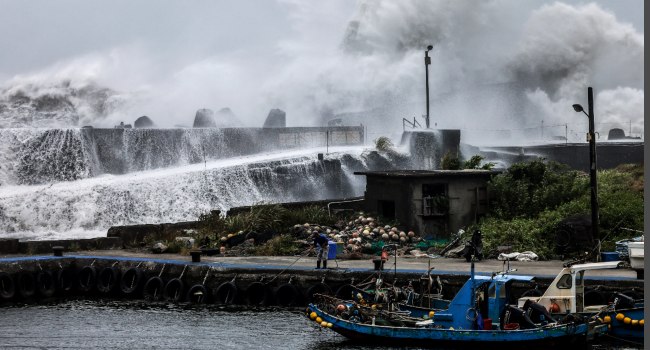
More than 900,000 people have been forced to flee their homes in China as Typhoon Bavi advances, after already bringing destructive winds and power outages to northern Taiwan and Japan’s remote southwestern islands on Saturday.
The approaching storm follows a week of severe weather in southern and central China that has already claimed at least 39 lives, causing dozens of rivers to overflow and a reservoir dam to burst.
Typhoon Bavi is projected to hit the mainland early Sunday near Wenzhou, a major city of nearly 10 million residents in Zhejiang province. Local officials reported that 887,801 people had been evacuated by late Friday.
“The proactive, all-out mobilisation, which is sparing no effort or cost, is undertaken entirely to guard against the (worst-case) scenario,” Wenzhou authorities said in a statement.
In preparation, residents have been reinforcing metal storefront shutters with wood and taping up windows. The storm is predicted to drop exceptionally heavy rain across eastern Zhejiang and northeastern Fujian province.
Further north, over 100,000 additional residents were evacuated as authorities increased water discharges from Beijing’s Miyun Reservoir to make room for expected floodwaters.
Taiwan experienced deserted streets and widespread business closures. The storm knocked out power to more than 170,000 households, forced 14,000 people from their homes, and caused hundreds of flight cancellations.
Taiwan’s Central Weather Administration (CWA) noted that Bavi, which hit Guam and the Northern Marianas as a super typhoon earlier in the week, has weakened slightly. On Saturday, its maximum sustained winds reached 137 kilometers (85 miles) per hour, with gusts up to 173 kmh. The CWA warned of dangerous 10-meter waves and extremely torrential rain.
“Everyone is afraid of the severe weather and staying indoors, but I only came out because I have orders,” a breakfast shop owner surnamed Tsai told AFP in Taiwan’s port city of Keelung. “Some people are on duty and wouldn’t have anything to eat, so I still need to deliver food to them,” the 50-year-old said.
Heavy rains triggered by Bavi caused landslides and flooding, raising the death toll to 18, primarily on the southern island of Mindanao.
Nearly 11,000 people have fled their homes, and dozens of ports remain closed, forcing 313 vessels to seek shelter.
In Okinawa, the typhoon cut power to more than 18,000 homes and facilities, with the Miyako region suffering the worst of the impact. Dozens of flights were cancelled, disrupting travel for over 26,000 passengers.
“Miyako is taking worst of typhoon Bavi,” professional storm-chaser James Reynolds posted on X from Ishigaki on Saturday. “Conditions on Ishigaki gale force with some overnight gusts to typhoon strength.”
According to the European Union’s Copernicus Marine Service, global ocean temperatures reached record highs this past June. Warmer waters provide more moisture and energy, allowing tropical storms to rapidly intensify and unleash heavier rainfall.
This trend is further amplified by the return of El Niño, a natural climate pattern that periodically warms Pacific surface waters.


