



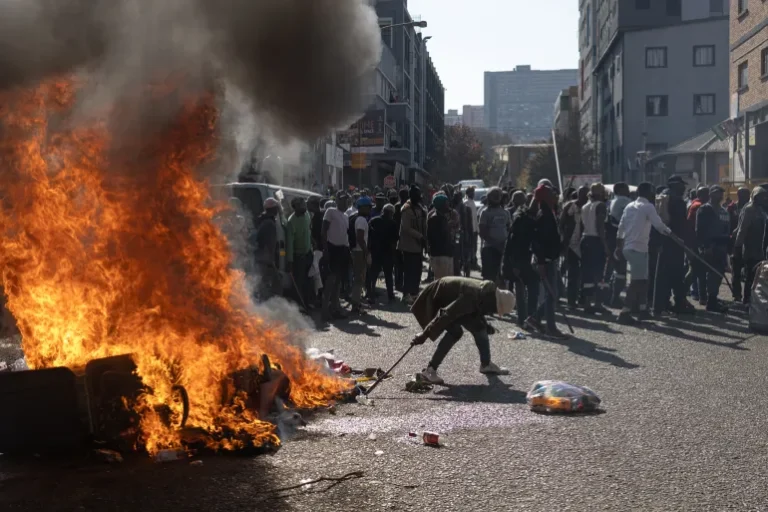
The South African government has firmly ruled out compensating Nigerians who left their properties behind after being evacuated from the country. Officials emphasized that assets located in informal settlements or acquired illegally are completely ineligible for reimbursement.
Furthermore, Pretoria maintained that individuals with legally acquired properties must sell them through the traditional South African property market rather than expecting any financial payout from the state.
This stance was reaffirmed by South Africa’s Minister in the Presidency, Khumbudzo Ntshavheni, who dismissed any ideas that the government would cover the costs of assets abandoned during past periods of unrest.
Her statements came in response to remarks from Nigeria’s Acting High Commissioner to South Africa, Temitope Ajayi.
Ajayi had revealed that the Nigerian government was looking into potential compensation routes for citizens who lost or walked away from their assets following their evacuation.
Speaking at a media briefing, Ntshavheni argued that South Africa has no grounds to issue these compensations.
She explained that all legitimately owned properties are officially registered with the appropriate authorities, whereas structures in informal settlements are deemed illegal and unrecognized by local laws.
She urged migrants holding legal deeds to utilize the real estate market.
“People with legitimate properties should sell them in the property market,” she said, underscoring that the state would not take responsibility for abandoned real estate.
The minister’s hardline stance drew sharp criticism from former Nigerian Senator Shehu Sani, who expressed shock at the tone of the refusal.
Reacting on social media, Sani wrote: “This is from a SENIOR Government official and NOT a thug from the streets.”
Ntshavheni doubled down on her comments in response to the backlash.
“I didn’t stutter. Any form of property obtained illegally won’t be compensated for,” she countered.
Alongside the property dispute, the minister renewed South Africa’s appeal to the Nigerian government for intelligence regarding locations tied to drug-related offenses, stating that such data is vital for law enforcement to tackle organized crime.
This latest friction intensifies the historically rocky diplomatic ties between Nigeria and South Africa over the treatment of Nigerian expatriates. Relations soured significantly following waves of xenophobic violence targeting foreign nationals, which saw businesses and homes looted, vandalized, and destroyed across multiple South African cities.
The severity of those attacks forced the Nigerian government to orchestrate a voluntary, state-assisted evacuation program for hundreds of its citizens. While the violence sparked continental outrage and prompted Nigeria to demand stronger protections for its diaspora, Pretoria promised tighter security and prosecutions. Both nations have since set up diplomatic channels to address ongoing friction surrounding migration, crime, and safety.


