

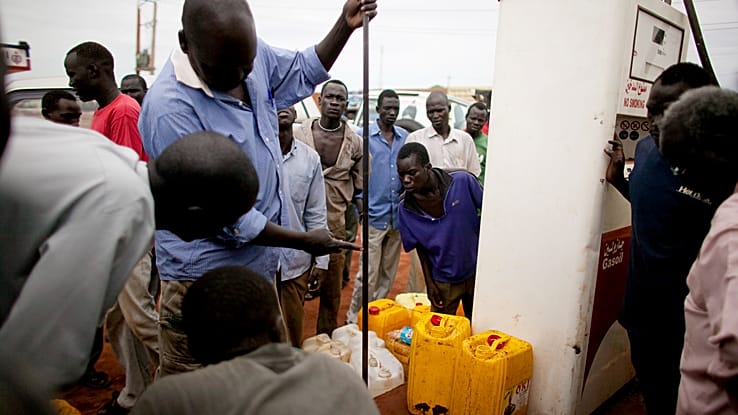
A worsening fuel shortage has brought everyday routines across Sudan to a standstill, leaving endless lines of vehicles outside the handful of petrol stations still in operation.
As the country’s civil war drags on, domestic fuel production has been severely damaged by drone strikes hitting critical infrastructure and energy facilities. At the same time, ongoing conflict in the Middle East since late February has triggered sharp swings in global energy prices.
Waiting inside his vehicle at a Khartoum filling station, local resident Osman Faisal noted that he had joined the queue at 7:00 a.m. and had already been stuck there for more than two hours.
“I don’t know how much longer I’ll have to wait. I haven’t been able to fill up for a week,” he said.
“And the price of gasoline has further gone up recently. Now it costs about $58 per gallon. It has increased by over $8 in just several days.”
The pressure from volatile international oil markets has been worsened by the sharp drop in the value of the Sudanese pound against the US dollar, driving up the cost of every imported fuel shipment.
Adnan Osman, another Khartoum resident waiting in line for fuel, expressed hope that the exchange rate would soon steady.
“Every morning when we wake up, we are forced to make a choice – go to work or queue for petrol,” he said.
Beyond stalling daily commutes, the scarcity of fuel has inflated transport and freight expenses, resulting in steeper prices for groceries and basic household goods.
“The prices of food, including vegetables and bread, are also on the rise. The life of everyone in this country is being severely affected,” said resident Alrazy Mohamed.
The crisis is also taking a heavy toll on the broader economy and deepening the nation’s humanitarian emergency.
Continuous fighting between the Sudanese Armed Forces and the paramilitary Rapid Support Forces since April 2023 has forced key oil fields to halt operations. With the Khartoum refinery, which previously supplied roughly 70 percent of the country’s fuel, now closed and multiple oil fields out of commission, Sudan has become almost completely dependent on foreign imports.
Squeezed between climbing global oil prices and a collapsing local currency, station operators are left constantly adjusting their prices and frequently shutting off their pumps.
