



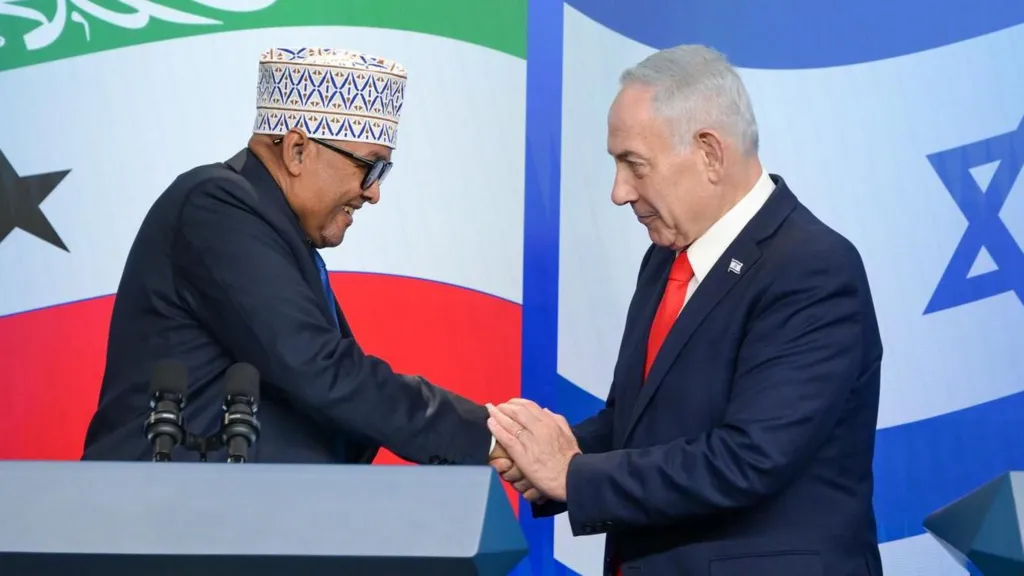
Somaliland has officially opened a new diplomatic mission in Jerusalem, marking six months since Israel became the first global nation to formally recognize the breakaway state’s independence.
The establishment of the embassy, located within a technology park in West Jerusalem, coincided with an official state visit to Israel by Somaliland’s President Abdirahman Mohamed Abdullahi.
During their high-level meeting, Israeli Prime Minister Benjamin Netanyahu highlighted the connection between the two nations, speaking of “a deep spiritual bond between our peoples”.
However, the move has drawn sharp criticism from Somalia, which maintains that Somaliland remains an integral part of its sovereign territory. The Mogadishu government condemned the diplomatic track, describing any engagement with “the secessionist administration of the northern region of Somalia… [as] a violation of its sovereignty”.
Israel’s initial decision to recognize Somaliland last December triggered widespread geopolitical pushback. A diverse group of nations and international bodies, including China, Turkey, Saudi Arabia, and the African Union, publicly criticized the announcement at the time.
Despite the international friction, Israel and Somaliland have continued to deepen their bilateral relationship. Earlier this year, Israeli Foreign Minister Gideon Saar traveled to the Somaliland capital of Hargeisa for an official visit.
The Significance of the Jerusalem Location
Somaliland’s choice to base its diplomatic mission in Jerusalem rather than Tel Aviv, where the majority of foreign nations maintain their embassies, earned distinct praise from Netanyahu.
The status of Jerusalem remains one of the most contested issues in international diplomacy. Israel occupied East Jerusalem during the 1967 Middle East war and formally annexed it in 1980, a declaration rejected by the vast majority of the global community. While Israel claims the entirety of Jerusalem as its “eternal and undivided” capital, Palestinians envision East Jerusalem as the future capital of their independent state.
Consequently, most nations, including the United Kingdom, have kept their embassies in Tel Aviv.
The United States broke with this convention in 2018 by moving its embassy to Jerusalem during Donald Trump’s first presidential term. Since then, a small group of nations, including Guatemala, Honduras, Kosovo, Papua New Guinea, Paraguay, and Fiji, have followed suit.
The Palestinian Authority’s foreign ministry strongly denounced the latest development, releasing a statement via the Palestinian News Agency, Wafa, condemning “the opening of the alleged embassy by the so-called ‘Somaliland’ in the occupied city of Jerusalem”. The ministry added that it “considered this step a flagrant violation of international law and relevant resolutions of international legitimacy”.
In contrast, Netanyahu expressed deep gratitude for the embassy’s placement in the city, which he called “our ancient capital”, while drawing a parallel to Somaliland’s ongoing global campaign for sovereignty.


