
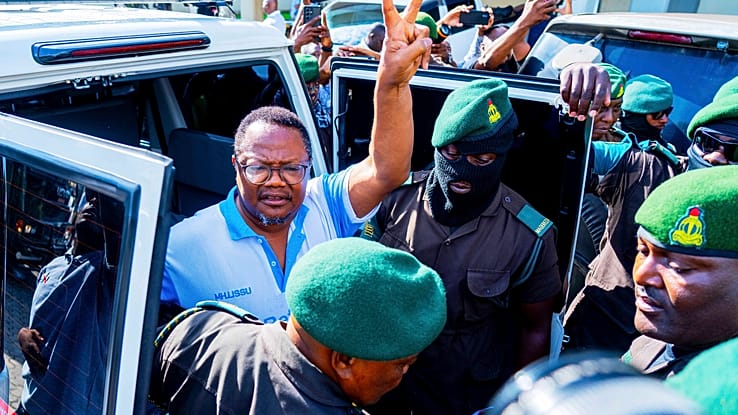
Tanzanian opposition leader Tundu Lissu was handed a four-year prison sentence on Friday for incitement. While he avoided a conviction on the more severe charge of treason, which carries the death penalty, the court’s ruling has ignited widespread international condemnation.
Tanzania, historically recognized as one of Africa’s stable democracies, has experienced a sharp decline in its political reputation as the long-ruling administration continues a severe crackdown on opposition figures and public protests.
Lissu, who leads the primary opposition party Chadema, spent 19 months in custody following his arrest on treason charges ahead of the previous year’s presidential election.
During the judgment, the court cleared the 58-year-old politician of treason. However, despite it not being listed among the original charges, the bench convicted him of incitement and issued the four-year sentence.
“We are satisfied that through his statements, the accused intended to disrupt elections and instigate violence,” the judge stated to a courtroom crowded with Lissu’s supporters.
Lissu denounced the legal proceedings as “political persecution,” claiming the judiciary acted under direct orders from the administration of President Samia Suluhu Hassan.
“Excuses were created to imprison me,” Lissu told the court. “I was not charged with incitement but you judges are convicting me with it just to impress the person who gives you the titles. I believe these were directives,” he said.
Ahead of the October 2025 vote, Hassan’s government executed widespread arrests and detentions targeting political opponents and government critics. The election, which Hassan won with 98 percent of the vote, triggered mass demonstrations. Human rights groups and opposition parties state that security forces killed thousands during the unrest, though official government figures report 518 deaths.
Security forces maintained a heavy presence across the commercial capital of Dar es Salaam and surrounding the court prior to the sentencing, with police issuing warnings against “those who want to stage a coup.”
Analysts had previously warned that a treason conviction could spark additional unrest across the nation.
“It’s a dark day for the rule of law and good governance in Tanzania,” stated opposition lawmaker Ado Shaibu, who serves as secretary general of the ACT-Wazalendo party.
The proceedings drew sharp rebukes from European Union and British lawmakers, who called the prosecution politically motivated and urged Lissu’s immediate release.
“The use of capital punishment against a political opponent risks turning the justice system into an instrument of political repression,” the lawmakers stated in a joint letter to Tanzania’s president.
US Ambassador to Tanzania William Trachman also voiced concern on social media, writing on X, “I am closely following the outcome of Tundu Lissu’s trial proceedings, and the broader implications for the rule of law.”
This trial marks only the third high-profile treason case in mainland Tanzania’s history. Previous cases in the 1970s and 1980s involved accusations of plots to overthrow and assassinate founding president Julius Nyerere.
Although Lissu has faced numerous arrests throughout his career, this was the first time he faced charges of this magnitude. In 2017, he survived an assassination attempt in which he was shot 16 times, an attack he maintains was politically orchestrated and which required nearly 20 surgeries.
