

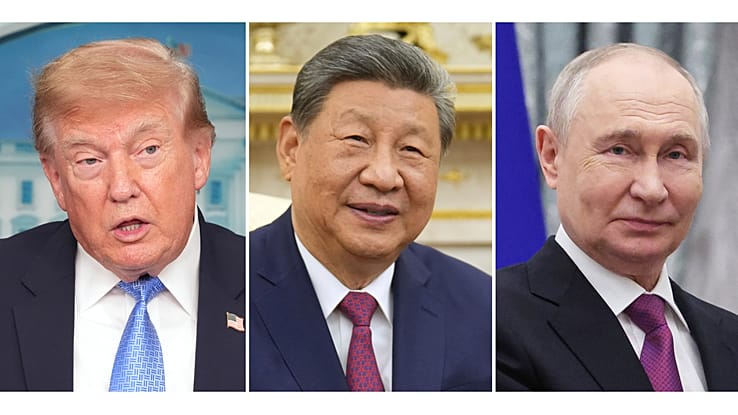
As the southern Chinese city of Shenzhen gears up to host the Asia-Pacific Economic Cooperation summit, all eyes are on an unprecedented diplomatic encounter set to unfold on the sidelines.
On Thursday, President Donald Trump is scheduled to meet with Chinese President Xi Jinping and Russian President Vladimir Putin in a rare three-way summit bringing together the leaders of the world’s largest nuclear powers, a development that has left traditional US allies questioning their standing.
According to Jonathan Czin, a former CIA China analyst now with the Brookings Institution, the true weight of the meeting lies not in tangible policy deals, but in the signal it sends regarding Trump’s posture toward global rivals.
“What will be more important than the substance of this meeting is going to be the subtext,” Czin said, noting that allied nations across Europe and Asia might interpret the gathering as a sign that Washington is prioritizing accommodation over containment when dealing with Beijing and Moscow.
The sit-down represents a dramatic shift from Trump’s first term, during which his administration formally labeled China and Russia as America’s primary strategic competitors.
“We’ve gone 180 degrees from saying these are the main problems we face in the national security space for the US government, to now we’re going to have a major meeting with these two leaders,” Czin said.
While nuclear arms control is slated to be a core topic, Trump also aims to bring up the conflict in Iran and Russia’s ongoing war in Ukraine. On Monday, the president confirmed he plans to discuss Ukraine with both leaders, contradicting statements from administration officials last week who indicated the war was off the agenda.
Meanwhile, Ukrainian President Volodymyr Zelenskyy has voiced unease over the idea of major global powers negotiating spheres of influence without Kyiv present at the table.
Czin believes Putin stands to gain the most politically from the summit, as it grants the Russian leader a prominent global platform alongside Trump and Xi despite ongoing Western efforts to isolate Moscow.
“I think it’s a political coup for Putin,” Czin said. “Of the three men involved in this meeting, I think he probably is the one who’s gaining the most.”
Beijing also sees strategic value in the talks, Czin explained, as hosting the summit underscores China’s central role in global diplomacy while offering an avenue to ease economic and political pressure from Washington.
Although Trump has expressed interest in crafting a new nuclear arms pact that brings China into the fold, Beijing has historically refused to join such negotiations even as it rapidly grows its nuclear stockpile. Consequently, Czin anticipates the meeting will yield surface-level dialogue rather than meaningful breakthroughs on arms control.
The diplomatic push comes at a sensitive domestic moment for Trump, who is looking to project strength abroad after Republicans suffered setbacks in the midterm elections. Czin suggested the president views high-level engagement with Xi and Putin as a way to solidify his legacy and demonstrate global clout. However, Czin warned that Trump must avoid appearing to make concessions that compromise American interests, emphasizing the need to clearly define US priorities while reassuring allies they have not been abandoned.
From Beijing’s perspective, the gathering offers a chance to forge a new global consensus, according to Wang Huiyao, founder and president of the Center for China and Globalization.
“Last time when China, US and Russian leaders get together, that was 80 some years ago,” he said.
“Now we are at another turning point, we are at a more fragmented world, we are getting to a multipolar world, and the world is lacking strong directions.”
Ukraine war
One potential area for immediate diplomatic movement is the war in Ukraine. While Wang Huiyao acknowledged that an outright resolution is unlikely this week, he suggested the three leaders could lay the groundwork for future negotiations at upcoming international forums like the United Nations and the G20.
“This three leaders’ meeting could, you know, kick off some peace consensus that they can really get further strengthened at the UN with the Security Council, other members and even with the European Union and Ukraine to have a peace summit maybe at the UN sometime,” Wang said.
“Then maybe at G20 next month, there could be some even more progress on the ceasefire between Russia and Ukraine,” he added.
Wang Yiwei, Director of the Institute of International Affairs at Renmin University of China, views the trilateral talks as a supporting mechanism rather than a substitute for direct diplomacy between the warring nations.
“Ukraine and Russia, these two parts, need to directly negotiate,” he said. “But they’re not trusting each other.”
Because of that deep-seated mistrust, backing from both Washington and Beijing will be vital to bring Kyiv and Moscow to the negotiating table, Wang Yiwei noted.
Wang Huiyao added that the summit highlights China’s expanding ambitions and capacity to act as a global mediator.
“I think we are coming to a stage that China is the second largest economy, one of the, or probably the second largest military power and even if China is not there, it could also provide guarantor roles, could provide all those active roles there, and all the countries are coming to China and looking for help,” he said.
Ultimately, the stakes are equally high for the White House, as Trump looks to prove that his foreign and economic strategies can yield tangible wins for voters back home while navigating complex ties with both Moscow and Beijing.
“For President Trump also it is very important because after the ‘Waterloo’ in the midterm election,” said Wang Yiwei.
“So they need to get some beef back and then to show the policy still succeeds,” he added.
