



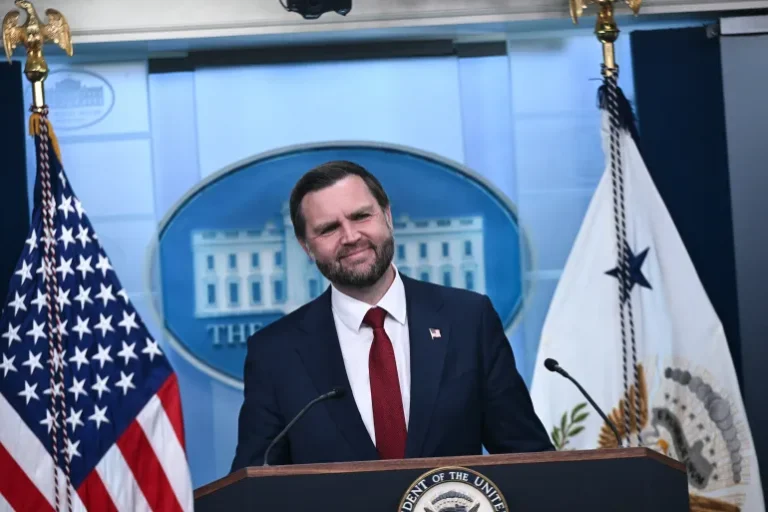
US Vice President JD Vance has refused to provide a clear timeline for the end of military operations involving the US, Israel, and Iran, despite growing domestic dissatisfaction and rising global energy prices tied to the ongoing crisis.
During a White House press briefing on Thursday, Vance attempted to minimize the scale of the confrontation, even questioning how the situation should be characterized.
“I wouldn’t call it a war. Right now, there is no active shooting,” Vance said, before adding, “I recognise there have been places where this has flared up.”
His comments follow days of heavy exchanges between US and Iranian forces. However, Vance maintained that primary combat operations lasted only about six weeks and asserted that the US military has successfully crippled Iran’s military manufacturing capacity.
Turning attention to the geopolitical blockade in the Strait of Hormuz—a crucial transit point for nearly twenty percent of global oil and gas—Vance placed the responsibility for ongoing disruptions squarely on Tehran. Traffic through the waterway was unhindered until February 28, when initial strikes by US and Israeli forces prompted Iran to close the route to merchant ships.
“When you ask, ‘When will this end?’, you’re asking me a question like: When will the Iranians stop shooting at ships?” Vance said to reporters. “I think the reality is, I don’t know the answer to that question. You’d have to ask the Iranians.”
Vance countered economic concerns by arguing that US military actions are paving the way for safer maritime transport. He also highlighted a recent agreement granting the US control over 65 billion barrels of Venezuelan oil reserves, which he claims will offset price surges.
“When will the Iranians shooting at ships stop having an effect on world energy markets? The answer is it has less effect day by day,” Vance said.
Criticizing international partners for insufficient support, Vance credited US President Donald Trump with preventing a wider global supply shock.
“What we’re doing right now is protecting commercial shipping in order to ensure that we don’t have a worldwide energy crisis,” Vance said. “The only reason we don’t have an energy crisis is because of the leadership of the president but also because of the fine work of our military.”
Addressing reports of a US strike hitting a wedding celebration in the coastal town of Sirik—an incident said to have killed at least five people, including children, and injured nearly 70 others—Vance stated an investigation was underway, though he expressed doubt regarding claims from Iranian authorities.
“We’re investigating it because obviously we care. We want to know,” Vance told reporters. “When our military makes mistakes, they learn from them to try to get better from them.”
While rights groups highlight the lack of accountability mechanisms for civilian casualties in foreign engagements, the US military maintains it does not target non-combatants. The administration previously disavowed an airstrike on an elementary school in Minab that killed over 150 people at the start of the conflict, despite evidence examined by international observers indicating the deployment of a US Tomahawk missile.
The broader region continues to bear a heavy human toll, with thousands killed across Iran and neighboring territories like Lebanon. Casualty reports through August indicate that 18 US service members have died and 750 others have been wounded since the onset of hostilities.


