

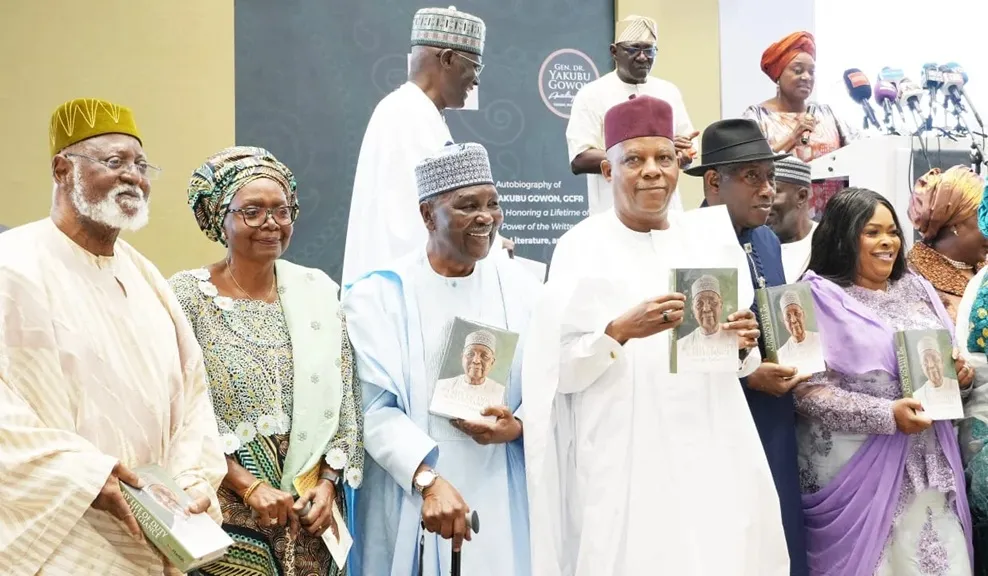
During the official launch of his 859-page autobiography in Abuja on Tuesday, former Head of State General Yakubu Gowon (retd.) issued a strong declaration of faith in the country’s endurance. Despite enduring severe political, economic, and security hurdles, Gowon insisted that Nigeria possesses the internal strength to navigate its current trials and eventually claim its destiny as the giant of Africa.
The unveiling of the book, titled My Life of Duty and Allegiance, served as a platform for the 91-year-old statesman to address the contemporary political landscape. He strongly cautioned the political class against the destructive nature of desperate politics and criticized the long-standing failure to execute credible and transparent elections, noting that even internal party selections remain flawed, a systemic issue he traced back to the colonial era.
Gowon urged citizens to reject defeatism and refuse to let outside critics brand the nation as a lost cause.
“We all must rise to contain the desperation frequently accepted by the political class who engage in what they love to call do-or-die politicking and their inability to conduct free, fair and transparent elections, even in matters as minor as intraparty elections, which has continued to plague our nation from colonial times,” he said.
“We must not give room to the naysayers who see no good in our nation and would rather label it as a failed nation.”
Reflecting on his time at the helm of the country, Gowon maintained his unwavering belief in Nigeria’s foundational strength.
“Each time I reflect on my service to my country, I become further persuaded that Nigeria can get better and achieve its potential as the giant of Africa,” he stated.
“On my watch as head of state, the country did not fall, and I am confident that the nation, despite all its challenges, still will not fall.”
However, he did express deep frustration with how national dialogue is often managed, pointing out a tendency among citizens to overcomplicate straightforward matters.
“I am worried that Nigerians never seem to get tired of presenting difficult solutions to simple problems, which they further complicate with more complex and ambiguous solutions that invariably generate tensions in the country,” he added.
Gowon’s tenure as military leader spanned from 1966 to 1975, a pivotal decade defined by the 30-month Nigerian Civil War and the monumental task of post-war reconstruction. His administration came to an end in July 1975 following a bloodless coup led by General Murtala Muhammed, which took place while Gowon was representing Nigeria at an Organisation of African Unity summit in Kampala, Uganda.
A Gathering of Statesmen and Legacy Tributes
The event drew an array of high-profile leaders who praised Gowon’s historical impact. Former President Goodluck Jonathan and former Defence Minister Theophilus Danjuma both lauded Gowon’s landmark “no victor, no vanquished” policy enacted at the close of the civil war, highlighting it as the cornerstone of Nigeria’s national healing.
READ MORE: Trump Pulls Back Iran Strike After Gulf Leaders Urge Restraint, Warns Attack Still on the Table
Jonathan remarked that the 859-page book represents far more than a standard autobiography.
“Today’s event is not merely the unveiling of a book. It is the presentation of a living testimony,” he said. “It is a reflection of a leader who stood at the centre of some of the defining moments in our national journey.”
He emphasized that the text serves as a masterclass in governance, peacebuilding, and navigating the friction of a highly diverse nation.
“The Nigerian autobiography offers not only a personal account of military strategy and leadership, but also one of the big insights into the challenges of nationhood, reconciliation, peace building, and statesmanship,” Jonathan added.
Looking back at the civil war years, Jonathan acknowledged the deep pain of that era while commending Gowon’s commitment to reconstruction.
“The years of the civil war from 1967 to 1970 remain among the most painful chapters of our national experience,” he said.
“Yet, this historical record is committed to the realisation of national unity and perhaps more importantly, the unanimity at the end of this conflict embodied in the enduring declaration of ‘no victor, no vanquished.’ The declaration laid the foundation for healing, reconstruction and reintegration at a time when victims and witnesses would have been in pain.”
Jonathan also pointed to the lasting institutional triumphs of Gowon’s administration, specifically the creation of the National Youth Service Corps (NYSC), noting that it fundamentally addressed teacher shortages in rural areas while fostering national cohesion. Sharing a personal anecdote, Jonathan recalled how the program directly impacted his own education.
“I remember in 1973, I was in class three in secondary school when the third batch of the NYSC came,” he said. “In those days, it was so difficult to get graduate teachers to teach in secondary schools, especially schools that were not in the cities.”
He credited two specific corps members deployed to his rural school with teaching him Mathematics, Chemistry, and Biology, which laid the groundwork for his academic future.
“So the vision of the NYSC is great and will continue to be great,” Jonathan stated.
Furthermore, Jonathan praised Gowon’s enduring post-presidential career, noting his continued focus on unity and interfaith harmony.
“General Gowon has continued to distinguish himself through decades of public service and advocacy for peace,” he said. “His commitment to national unity, interfaith harmony, and youth development has remained steadfast long after leaving office.”
He concluded by stressing the vital importance of leaders documenting their experiences for posterity.
“As younger generations study our nation’s history, it is important that they hear directly from those who bore the burden of leadership during critical times,” he said. “By sharing his stories, Gen Gowon has once again rendered another important service to Nigeria and the historical record of Africa.”
Echoing these sentiments, General Danjuma, whose remarks were delivered by former Chief of Defence Staff Martin Luther Agwai, praised Gowon’s steady hand during Nigeria’s darkest hours.
“As Nigeria’s Head of State during one of the most turbulent periods in our nation’s history, Gen Gowon exhibited immense courage and sterling character in steering our beloved country from the brink of disintegration to a united, stable and strong nation,” he said.
“His well-recorded slogan of ‘no victor, no vanquished’ after the civil war set the tone for his highly effective post-war policies, which helped to speedily heal the scars of the war and put Nigeria on the path to sustainable recovery.
He will forever be remembered as a leader whose love for his country and fellow citizens was unwavering even in the most trying of times.”
Massive Financial Backing and Dignitaries in Attendance
The launch attracted a massive gathering of Nigeria’s political and business elite.
Among the attendees were former Military President Ibrahim Babangida (represented by his daughter, Aisha Babangida), Senate President Godswill Akpabio (represented by Senator Ireti Kingibe), the Sultan of Sokoto Muhammad Sa’ad Abubakar III, Secretary to the Government of the Federation George Akume, and President of the Court of Appeal Monica Dongban-Mensem. The audience also featured numerous retired top military brass and family members of past leaders, including the son of former Head of State Sani Abacha.
The book launch saw extraordinary financial support. General Danjuma announced a personal donation of N3 billion, alongside a directive to distribute copies of the memoir to the libraries of 20 universities that have previously conferred honorary doctorates upon Gowon.
Additionally, Dangote Group Chairman Aliko Dangote contributed N500 million, while BUA Group President Abdul Samad Rabiu backed the launch with a book purchase worth N25 million. The comprehensive autobiography was formally reviewed by Matthew Kukah, the Catholic Bishop of Sokoto Diocese.
