
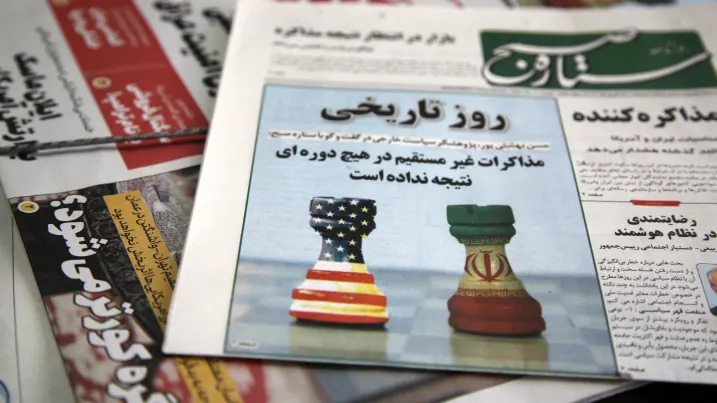
Initial market relief following the interim agreement between the U.S. and Iran quickly dissolved into fresh uncertainty on Friday.
Planned follow-up negotiations in Switzerland were abruptly called off, highlighting the steep hurdles ahead in turning the initial agreement into a lasting peace settlement.
According to Switzerland’s foreign ministry, the U.S.-Iran talks that were set to take place at Bürgenstock on Friday did not proceed as anticipated.
In tandem, the White House confirmed that Vice President JD Vance canceled his travel to Switzerland, pointing to unresolved logistical complications surrounding the meetings.
“The plans for the upcoming technical talks have not been finalized, and the U.S. delegation has been prepared to depart at the first available opportunity,” a White House spokesperson remarked. “But the logistics of these negotiations have never been simple or predictable.”
The sudden breakdown occurred just a day after President Donald Trump and Iranian President Masoud Pezeshkian signed a memorandum of understanding (MOU) to establish a roadmap for a permanent peace deal to resolve months of intense conflict. Under the 14-point MOU, both nations committed to extending a ceasefire—which included Lebanon—and reopening the vital shipping lanes of the Strait of Hormuz.
However, sources familiar with the matter told the Financial Times that Friday’s session was canceled due to a sudden escalation of deadly Israeli airstrikes in Lebanon. Lebanon’s Health Ministry reported that overnight Israeli strikes killed 18 people in the southern part of the country, while Israel reported that four of its own soldiers were killed.
Israeli Prime Minister Benjamin Netanyahu posted on social media Friday morning that he had directed the Israel Defense Forces to strike Hezbollah “with full force” following what he described as a “heinous attack” by the Iran-backed group.
The situation shifted again hours later when a U.S. official told CNBC that the two factions had agreed to a ceasefire starting at 4 p.m. local time (9 a.m. ET), causing oil prices to slide.
Market analysts are warning that the U.S.-Iran pact is merely a preliminary step in a complicated process.
“While an important breakthrough, this agreement marks really the beginning rather than the end of the process to try to end the war and address Iran’s nuclear capabilities,” UBS noted in a research report.
Even with the surrounding friction, the interim deal has managed to ease tensions in the Strait of Hormuz. Shipping in the region had previously been choked by Iranian attacks and a U.S. Navy blockade of Iran’s coastline ordered by Trump.
David Roche, a strategist at Quantum Strategy, noted on CNBC’s “Squawk Box Asia” that smoother shipping lanes could aid nations dependent on oil imports by lowering energy costs, which helps curb inflation and lessens the pressure on central banks to hike interest rates.
However, Roche offered a grim assessment of the geopolitical fallout.
“Beyond that, this is a really bad deal,” Roche said, arguing that it strengthens Iran’s hand in the Gulf and shields its domestic affairs from foreign intervention.
“Iran is going to make the Middle East very unstable, that’s bad in the long term,” Roche added, predicting that Israel would reject the terms. “Iranians, I will predict you confidently, will never, never abandon their nuclear ambitions,” Roche said.
The deal has faced swift blowback from critics who claim the U.S. gave up too much leverage, forcing both Trump and Vance to go on the defensive.
“The United States isn’t giving up a cent of money to Iran,” Vance stated in defense of the administration’s strategy.
Trump took to Truth Social on Thursday to aggressively dismiss his detractors.
“These fools, who think I haven’t been tough enough on Iran, when the Stock Market Just Hit A RECORD HIGH, and Oil prices are ‘tumbling’ down, are either jealous, bad people, or stupid,” Trump wrote.
