
Escalating hostilities in the Strait of Hormuz threaten global energy corridors despite a minor diplomatic breakthrough
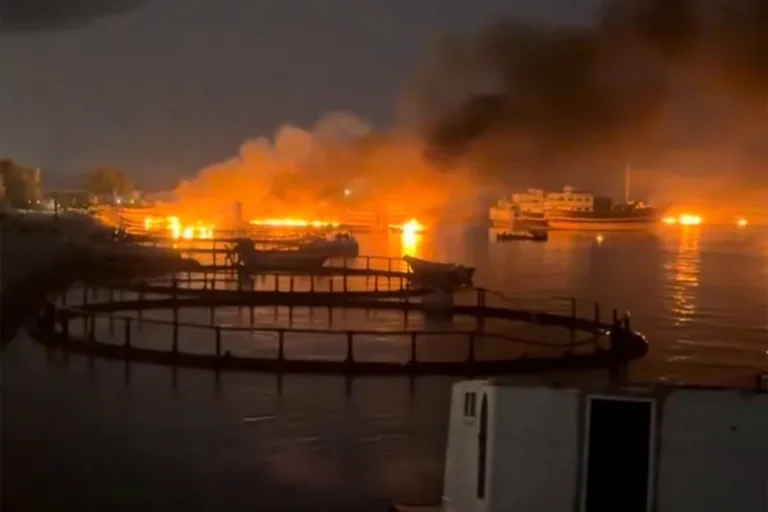
The United States military has fired on an oil tanker attempting to reach Kharg Island in the Strait of Hormuz as part of an active blockade on Iranian ports. This marked the fifth consecutive day of American military operations, which also saw the capital city of Tehran come under direct attack for the first time in this latest round of hostilities.
According to US officials, naval forces disabled the unladen oil tanker on Thursday morning. The vessel was targeted with Hellfire missiles fired directly into its smokestack after it reportedly ignored multiple warnings to halt.
This rapid escalation comes just days after a recently brokered ceasefire between Washington and Tehran completely collapsed, raising international anxieties over a potential slide into full-scale war.
A Rapidly Expanding Combat Zone
On Wednesday evening, American forces targeted Iranian coastal defense systems and missile installations. This followed an earlier round of strikes on Wednesday morning that neutralized cruise missile storage and launch facilities on Iran’s Greater Tunb Island.
The Pentagon also pushed its aerial campaign further north. Iranian state media confirmed strikes inside the capital city of Tehran, where residents reported hearing air defense systems firing throughout the early hours of Thursday.
In response, Tehran launched retaliatory strikes targeting Bahrain and Kuwait. While there was no immediate data on casualties or structural damage from these retaliatory strikes, Iranian authorities claimed that the recent wave of US attacks had already killed more than 35 people and wounded over 300 others in Iran.
According to the US military’s Central Command, the operations are designed to degrade Iranian military assets “used to threaten vessels freely transiting through the Strait of Hormuz, an international waterway vital to global commerce.”
Local reports indicate that American missiles hit four separate locations around the city of Ahvaz, the primary port city of Bandar Abbas, and areas near Sirik and Qeshm in southern Iran.
The Fight Over the World’s Most Critical Oil Chokepoint
The direct military confrontations intensified after Tehran announced on Saturday that it was shutting down the strategic Strait of Hormuz. The waterway is highly critical to the global economy, previously carrying roughly 20 percent of the world’s oil and gas supply.
Following the closure, the US reimposed its naval blockade on Wednesday.
The Islamic Revolutionary Guards Corps (IRGC) quickly fired back with a threat to shut down all energy transit in the region, warning: “Regional energy exports are either shared by all or denied to all.”
The ongoing combat has sent jitters through global markets. Brent crude prices climbed above $85 per barrel on Wednesday a 15 percent jump from pre-war baselines, though still short of the $120 peaks recorded during earlier stages of the conflict.
Political Posturing and Crumbling Diplomatic Accords
Speaking to a crowd in Pennsylvania on Wednesday, US President Donald Trump predicted a swift end to the conflict, claiming that Iran would be “defeated soon” and asserting that the Iranians wanted to “settle so badly.”
This followed comments from Trump on Tuesday, where he revealed that American negotiators had delivered a blunt warning to their Iranian counterparts: “you better make a deal.”
Trump has also hinted at broadening the scope of the US military campaign to force the Strait of Hormuz open, warning that the US could target “Pickaxe Mountain,” a heavily fortified underground site associated with Iran’s nuclear program.
The sudden return to active warfare comes only weeks after both nations signed a memorandum of understanding (MOU) to halt fighting and resume nuclear negotiations. However, Tehran’s leadership indicated that the agreement is practically dead.
Mohammad Bagher Ghalibaf, Iran’s chief negotiator, warned that the agreement is only useful if its “clauses are valid and being implemented.” He noted:
“If Iran is not to derive any benefit from the memorandum of understanding, we have no reason to adhere.”
Ghalibaf further asserted that Iran’s national security relies on maintaining “Iranian arrangements” in the Strait of Hormuz, declaring that the country is locked in an “essential and existential war with America.” Iran’s military spokesperson reiterated that the Strait would only reopen if the US fully complied with the terms of the MOU.
A Fragile Gesture of Goodwill
Amid the intense military exchange, President Trump pointed to a rare sign of diplomatic cooperation late Wednesday. He announced that Iran had permitted an American citizen, who had been held since late 2024, to depart the country.
“The United States of America appreciates this gesture of goodwill by Iran,” Trump shared on Truth Social.
Human rights attorney Jared Genser identified the freed citizen as Dena Karari, who had been blocked from leaving Iran since December 2024.
“Dena is now safe and traveling back to the United States,” Genser posted on social media, expressing his gratitude to the administration for securing her release.
