
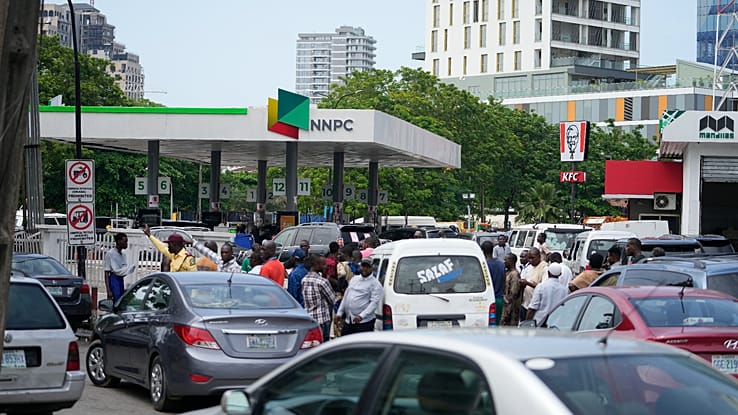
Ahead of the upcoming January 16 elections, Nigeria’s government has announced new measures to soften energy price shocks, including a temporary petrol discount for public transportation operators.
Despite hosting the continent’s largest refinery—owned by Africa’s richest man, Aliko Dangote—Africa’s top oil producer has seen pump prices surge to roughly 1,400 naira ($1.00) per liter, up from 830 naira prior to the conflict in the Middle East. The rise follows earlier decisions by the government to step back from direct price controls and let market forces dictate costs.
Fuel costs had already spiked after President Bola Tinubu, who is campaigning for re-election, scrapped long-standing fuel subsidies at the start of his term, turning energy affordability into a central political debate.
Finance Minister Taiwo Oyedele explained on Thursday in Abuja that the new steps aim to alleviate pressure on households and businesses without returning to a full subsidy system. He stated that state-owned NNPC Limited will offer a discounted rate on petrol for an initial 30 days, prioritizing commercial transit operators across the nation. Oyedele clarified that “It’s not a subsidy. The government is just saying we sell to you at cost,” though he did not disclose the specific discounted rate.
Since taking office in 2023, Tinubu has driven significant economic reforms, most notably ending the expensive fuel subsidy and floating the local currency. While many economists supported the structural changes, the immediate result was a sharp increase in the cost of living for residents in Africa’s most populous nation. Cheap, subsidized petrol had long served as a rare direct benefit for citizens facing decades of weak public infrastructure and corruption. Tinubu maintains that removing the subsidy was necessary to avoid a severe fiscal crisis.
Political rivals have pushed back on the announcement. The Nigeria Democratic Congress, supporting presidential candidate Peter Obi, labeled the relief package an “attempt to re-introduce petrol subsidy through the backdoor.” Obi recently stated in an interview that his approach to lowering consumer costs relies on curbing corruption.
Another opposition candidate, Atiku Abubakar, publicly questioned the temporary nature of the policy, asking what happens on day 31 when citizens face the same high transportation and food costs. Abubakar proposed an alternative “targeted” subsidy scheme, describing it as a capped production support model linked directly to fuel processed within Nigeria.
To handle long-term volatility, the government plans to implement what the finance minister termed “price modulation” to smooth out pump price swings. Oyedele explained that pump prices shouldn’t shift with every fluctuation in international crude markets or currency rates, noting that officials are currently negotiating a cost ceiling of 1,350 naira per liter. Under this framework, if actual costs exceed the cap, refiners and importers will absorb the difference and recover it later when market conditions improve. Oyedele emphasized that this mechanism is neither a subsidy nor a strict price control, and the ceiling will be reviewed on a monthly basis.
