

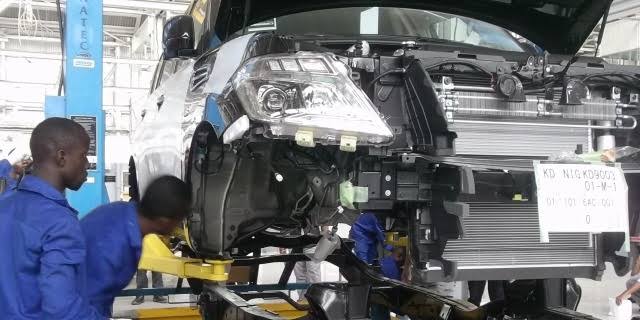
Under its Nigeria First Policy, the Federal Government has called on local vehicle manufacturers to scale up production capacity, enhance product quality, and offer reliable after-sales services as it moves to prioritize homegrown automotive plants in government procurement.
The Director-General of the National Automotive Design and Development Council (NADDC), Oluwemimo Joseph Osanipin, revealed in Abuja that the country’s vehicle assembly facilities possess an annual manufacturing capacity of 370,520 vehicles. He noted that giving priority to domestic manufacturers during procurement processes will generate employment, curb foreign imports, and boost the local manufacturing of automotive components.
Osanipin explained that the strategy represents a major policy overhaul, requiring all vehicles acquired by government ministries, departments, and agencies (MDAs)—including utility vehicles designated for projects—to be bought exclusively from licensed domestic assembly plants or their accredited dealers.
“We are fundamentally shifting the Nigeria First Policy. All vehicles procured by ministries, departments and agencies, including project utility vehicles, must be sourced exclusively from licensed local assemblers or their authorised retailers.
“Also, no ministry, department or agency may procure a foreign-assembled vehicle unless it explicitly proves the absence of a domestic alternative and obtains direct presidential clearance.
“Every vehicle supplied to the government must carry a traceable Vehicle Identification Number (VIN) verified through the NADDC. Any supply outside licensed local assembly lines will attract immediate regulatory sanctions, including blacklisting and licence revocation,” he explained.
To ensure compliance, any government agency seeking to purchase imported vehicles must provide clear proof that no suitable domestic equivalent exists and secure explicit approval from the presidency.
The Bureau of Public Procurement (BPP) has cautioned local manufacturers that delivering subpar products, offering poor maintenance support, or violating policy terms will result in strict penalties. The agency reiterated that every vehicle delivered to public institutions must feature a traceable Vehicle Identification Number validated by the NADDC.
BPP Director-General Adebowale Adedokun urged local assemblers to invest heavily in advanced technology, stringent quality assurance, and comprehensive repair services as part of the broader effort to establish a competitive automotive industry in Nigeria. He stressed the necessity for domestic companies to elevate product standards and service delivery to satisfy government requirements under the Nigeria First Framework.
The initiative aims to fortify the local assembly ecosystem, spur domestic component manufacturing, diminish reliance on foreign vehicle imports, and expand employment opportunities across the nation’s automotive sector.
