

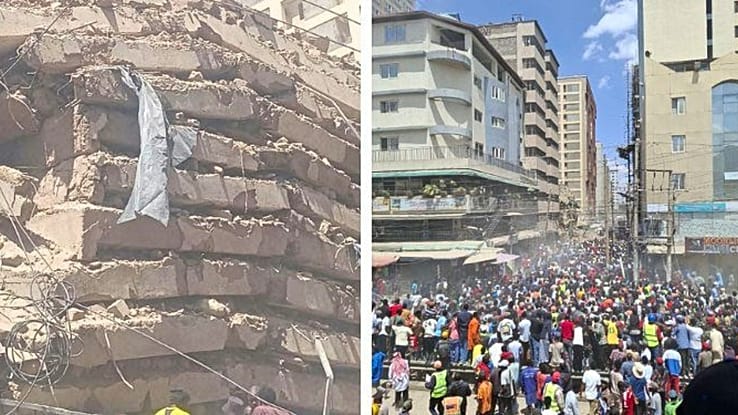
A multi-storey building under construction collapsed on Friday in Nairobi, the capital of Kenya, leaving many people feared trapped under the debris and sparking intense outrage over dangerous construction practices.
Eyewitness videos shared online recorded the dramatic moment the structure—believed to be approximately 18 storeys tall—crumbled into a vast cloud of dust. The incident occurred around lunchtime in Eastleigh, a densely populated commercial and residential district renowned for its vibrant markets and large Somali community.
Emergency search and rescue teams quickly arrived at the scene but faced significant challenges accessing the site, as the collapsed structure was reduced to a massive pile of rubble tightly wedged between adjacent high-rise buildings.
Police forces managed to pull one woman alive from the debris and reported hearing the voice of another survivor trapped underneath. Shortly after the collapse, local media reported instances of looting, prompting police officers to deploy tear gas to disperse gathering crowds.
Industry experts on-site expressed deep concern over ongoing safety lapses and lack of oversight in the local building sector.
“There are lots of people trapped here,” Bibiye Mahmoud, president of the Institution of Engineering Technology of Kenya, told AFP at the disaster site. “The contractors and the engineers are supposed to ensure that the works are followed by professionals. But most are not. This is why we are seeing these catastrophes… There is no accountability,” she added.
Nairobi Governor Johnson Sakaja addressed reporters at the scene, stating, “Our concern is to save lives,” while pointing out that “This building has no occupation certificate…this has potentially cost lives.” An occupation certificate serves as official municipal authorization confirming that a structure is legally compliant and safe for occupancy.
John Ogallo, vice-president of the Institution of Engineers of Kenya, noted that clear warning signs preceded the tragedy. “People here are saying distresses were observed, like cracks,” he told reporters, emphasizing that if you build with the wrong materials, “it becomes a time bomb.”
The collapse highlights persistent structural safety issues during Nairobi’s ongoing rapid real estate expansion. Data from the official statistics bureau shows that the number of completed buildings in the city climbed from 20,025 in 2022 to 25,090 last year, driven by a growing population moving from rural areas and neighboring nations to East Africa’s central business hub.
However, official assessments reveal widespread regulatory failure and corruption, which frequently allow contractors to bypass safety standards or cut corners. An audit conducted last year by Kenya’s National Building Inspectorate revealed that 87 percent of inspected buildings nationwide failed to satisfy basic safety criteria or lacked required regulatory approvals.
According to a study by the Kenya Institute for Public Policy Research and Analysis, Nairobi experienced 86 building collapses between 2009 and 2019, resulting in roughly 200 fatalities. Similar tragedies have continued in recent years, including a six-storey building collapse in September 2022 that claimed five lives on Nairobi’s outskirts, and an April 2016 apartment building failure during heavy rainfall that left 49 people dead in the capital’s northeast.
