

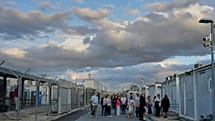
The Associated Press was recently granted rare access to an upgraded reception camp near Nicosia, Cyprus, where several migrants have found shelter.
Among them is 24-year-old Mbah Damaris Menemah, who shared that her family in Cameroon cast her out after discovering her secret.
“In my country, lesbians are not accepted,” she told The Associated Press at Cyprus’ Pournara migrant reception center.
“So when my family found out, they weren’t so happy with it…They cursed me over. They rejected me because of that.”
Menemah expressed that if her family and local community could not accept her identity, she intended to seek a life elsewhere “where I’ll be regarded as somebody.”
Like many other asylum seekers, Menemah initially secured a student visa to enter the breakaway Turkish Cypriot north of the ethnically divided island. With assistance from human smugglers, she subsequently crossed into the south via a porous United Nations-controlled buffer zone.
Although Cyprus joined the European Union in 2004, full membership benefits apply exclusively to the southern region, where the island’s internationally recognized government is situated.
Menemah stated that she hopes another EU country will take up her asylum case, as she has been informed that Cyprus may not be able to process it.
At the time of the visit, Menemah was among 343 migrants residing at the facility, a group that includes 72 unaccompanied minors. Officials at the site noted that the majority of residents arrived from countries such as Somalia, Sudan, Yemen, Cameroon, Congo, Syria, and Burundi.
Media access was granted alongside a visiting delegation from Eurojust (the European Union Agency for Criminal Justice Cooperation) following a multimillion-euro modernization of the facility, funded by the EU and the International Organization for Migration (IOM).
Only a few years ago, the former abandoned army site functioned as a severely overcrowded facility where residents lived in tents subjected to extreme summer heat and winter mud. The outer fence was damaged by large holes that failed to secure the perimeter.
The newly revamped facility has replaced the temporary tents with prefabricated buildings that host dormitories, a kitchen, a medical station, administrative processing areas, and counseling rooms.
The camp now provides round-the-clock staffing by nurses and interpreters. Recreational facilities include a soccer pitch, a children’s playground, and outdoor exercise equipment. Additionally, designated prayer areas have been established to accommodate the predominantly Muslim population currently at the center.
Security has also been heightened: police officers are stationed on site, entry and exit points are strictly monitored, and a 3-meter (10-foot) perimeter fence surrounds the center.
