



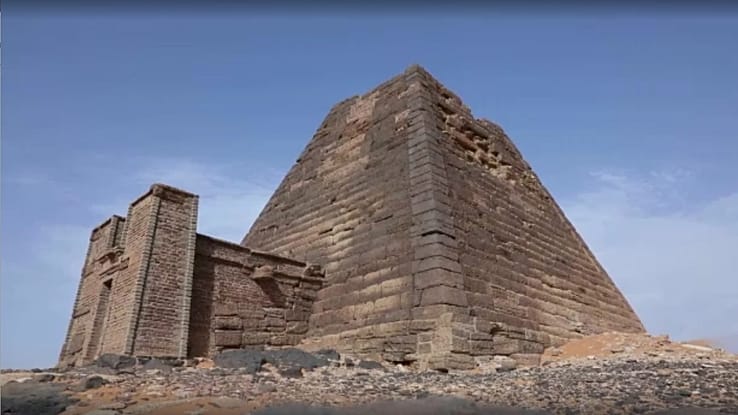
Sudan’s lingering civil conflict is endangering the famed pyramids of Meroe, a UNESCO World Heritage Site known for its distinctive angled design.
Situated roughly 200 kilometers north of Khartoum, the ancient grounds house more than 200 pyramids constructed between 800 BC and 350 AD to serve as royal tombs for Kushite rulers.
None of the structures remain fully intact today. Over time, European treasure hunters damaged many with dynamite during the 19th century, while two centuries of desert wind, sand, and rain have further eroded the remains.
Archaeologist Mahmoud Suleiman noted that their decay is driven by a mix of many “adverse” factors, including climate change, armed conflict, and the complete standstill of international conservation work.
“The biggest problem is that we come in the morning to find that stones have fallen, which is a huge problem,” said antiquities inspector, Mohamed Mubarak.
“Or we’d find salt inside the funerary temples in an area with inscriptions and drawings. The salt weakens the stone and eventually, it will make us lose these inscriptions.”
Reaching heights between 6 meters and 30 meters, the pyramids feature eastern entrances designed to face the morning sun. Built roughly 800 years before their famous Egyptian counterparts, the complex was once the premier heritage attraction in Sudan.
However, after more than three years of intense fighting between the national military and the paramilitary Rapid Support Forces, the historic grounds sit virtually deserted.
“Visitors were coming, missions were operating, and everything was fine until the year 2023 and the war,” said Mustafa Ahmed, one of the guards of the pyramids.
With no resolution to the hostilities in sight, the relentless desert elements continue to erode what remains of these ancient wonders.


