

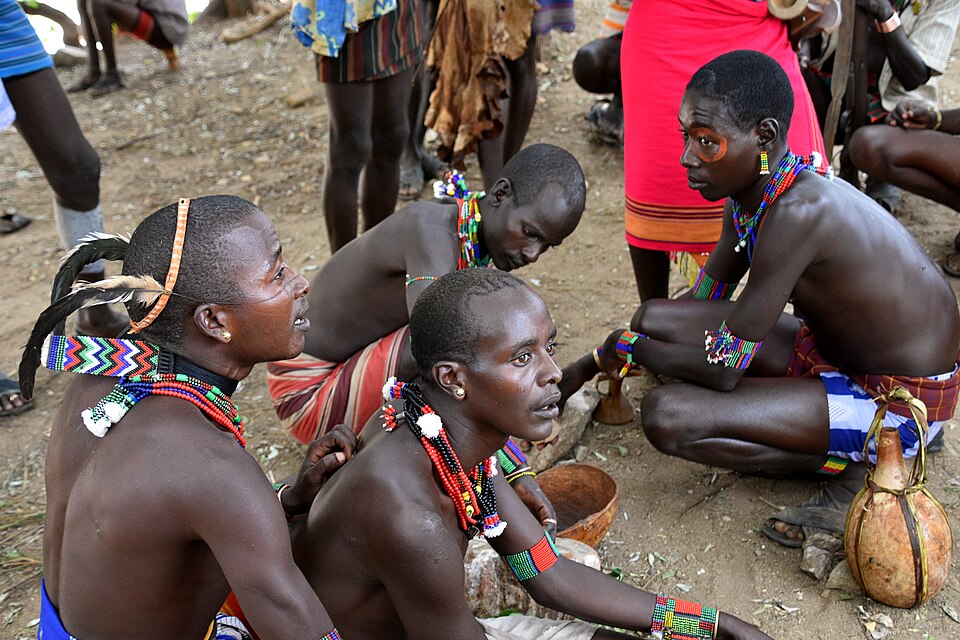
Deep within the sun-baked savannas of southwestern Ethiopia’s Omo River Valley, the rhythmic sound of iron ankle bells echoes across the dirt. This is the heartland of the Hamar, a proud agro-pastoralist community of roughly 50,000 people.
In a rapidly globalizing world, the Hamar have fiercely preserved a rich, visually stunning tapestry of social structures, where identity is worn like armor and marriage is a sacred contract sealed not by paper, but by cattle and courage.
1. The Crucible of Manhood: The Ukuli Bula
Before a Hamar man can even contemplate marriage, he must prove his readiness through the ‘Ukuli Bula’, the famous bull-jumping ceremony. This high-stakes rite of passage is an intense, multi-day communal affair that transforms a boy into a ‘maz’ (a mature, marriageable man).
The Leap of Faith: Surrounded by chanting, dancing villagers, the young initiate must strip naked, symbolizing the shedding of his childhood. He must run across the backs of ’10 to 15 slippery, mud-smeared bulls’ lined up side-by-side.
The Stakes: He must complete this traverse four times without falling. Success grants him the right to marry, own livestock, and sit with the elders. A failure brings deep social shame, forcing him to wait another year to try again.
2. Cowries, Copper, and Collars: The Status of Women
While men prove their valor through the livestock, Hamar women carry the visual narrative of the community’s social hierarchies. Their styling is highly intentional, using aesthetics to communicate status and resilience.
The Goscha: Women twist their hair into fine locks (goscha), binding them with a vibrant paste of ‘red ochre, water, and animal fat’, paired with elaborate cowrie-shell-decorated leather skirts.
The Marriage Collars (Esente): A Hamar woman’s neck rings tell her life story. A heavy iron collar with a distinctive front leather knob denotes a ‘first wife’, who commands the highest status and respect in the household. Subsequent wives wear simple, plain metallic bands.

3. The Architecture of Marriage: Wealth and Union
The Hamar practice polygyny, allowing a man to marry multiple wives, provided his family can afford the required bride price. Marriage within the community is less about individual romance and more about the strategic, lifelong union of two distinct clans.
This union begins with the negotiation of the ‘baito’, or bride price. To compensate the bride’s family for the loss of her labor and future offspring, the groom’s family must deliver a substantial payment, typically consisting of 20 to 30 cattle and up to 30 to 40 goats.

Once agreed upon, the marriage is consecrated with a grand communal feast featuring ‘parsa’ (traditional sorghum beer) and intense celebratory dancing, where the bride is formally escorted to her husband’s homestead.
Within the domestic sphere, roles are clearly defined: while men manage the livestock and regional defense, women wield massive authority over the daily operation of the homestead, directing agricultural cultivation and the rearing of children.
4. Preservation in a Changing Africa
Today, the Hamar navigate a delicate balance. The introduction of regional tourism, mobile technology, and environmental pressures on the Omo River basin present modern challenges to their traditional lifestyle.

Yet, their social fabric remains remarkably resilient. For the Hamar, culture is not a relic of the past, it is a living, breathing defense mechanism that keeps their identity whole.
