

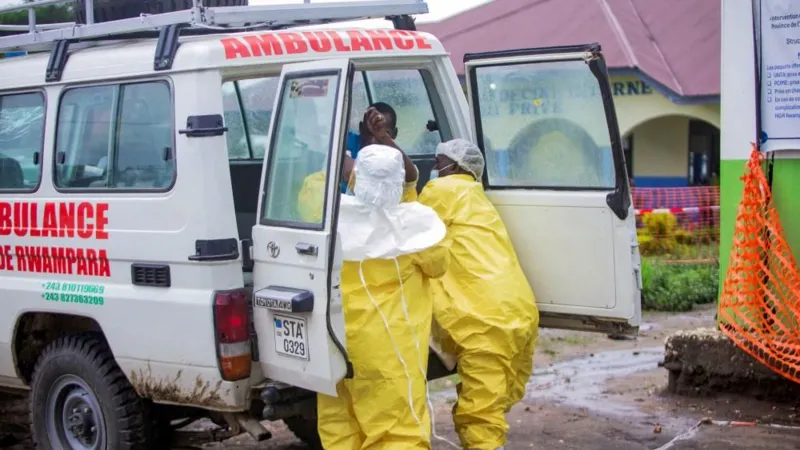
Scientists have officially launched a clinical trial evaluating potential treatments for the highly infectious Bundibugyo species of Ebola currently sweeping through the Democratic Republic of Congo.
World Health Organization (WHO) Chief Tedros Adhanom Ghebreyesus announced on Thursday that the first patient has officially been enrolled in the DR Congo.
According to the latest data from the WHO, the country has recorded over 1,400 confirmed cases and 438 deaths, and there are currently no approved vaccines or therapies for this specific strain of the virus.
The emergency trial is sponsored by the WHO and brings together local and international scientific bodies, including the Institut National de Recherche Biomédicale in DR Congo, the Institute of Tropical Medicine in Belgium, and the University of Oxford in the UK, to evaluate two specific antiviral medications on patients.
Speaking from the WHO headquarters in Geneva on Thursday, Tedros emphasized the critical importance of the trial, stating: “Even without approved therapeutics, people are recovering from this disease, but of course, we could save many more lives with safe and effective therapeutics in our toolkit.”
DR Congo’s Health Minister, Dr. Samuel Roger Kamba, echoed this sentiment, noting that the launch “represents a significant step forward, offering renewed hope to patients, their families, and affected communities”.
Though the official outbreak declaration was made in May, health authorities believe the virus was quietly spreading undetected for quite some time. As of July 1, the WHO has classified the situation as a public health emergency, recording 1,460 confirmed cases, 150 suspected cases, and 452 deaths in the DR Congo, alongside 213 recoveries.
The virus has also breached borders, with 20 confirmed cases and two deaths in Uganda, and one confirmed case in France.
Ebola damages organs and the human immune system. While it naturally circulates in animals like fruit bats, it spills over to humans through the handling of infected animals and spreads between people via contact with bodily fluids like blood.
Symptoms can take anywhere from two to 21 days to manifest, starting abruptly with fever, headache, and severe fatigue, though individuals are generally only contagious after symptoms appear.
While official containment zones remain focused on three eastern provinces, South Kivu, North Kivu, and Ituri, new transmission risks have emerged.
According to reports from Reuters and AFP, a pregnant woman who passed away in Ituri tested positive after her body was moved by motorbike to Kisangani, a major city of 1.5 million people in the neighboring Tshopo province. Furthermore, a suspected patient fled an isolation ward in Ituri, later testing positive in Haut-Uele province.
READ MORE: UN Chief warns millions of Palestinian refugees at risk as UNRWA faces critical funding crisis
In response, authorities have banned all public gatherings in Tshopo, Haut-Uele, Bas-Uele, and the capital city of Kinshasa to prevent a massive urban outbreak. Contact tracing is also actively underway across the newly exposed regions.
Obstacles to Overcoming the Epidemic
To keep pace with the spreading virus, DR Congo’s health ministry has successfully expanded its diagnostic capabilities, increasing the number of operational testing laboratories from four to ten.
However, public health bodies like the Africa CDC and US health organizations warn that because the virus circulated silently for weeks before confirmation, it has the potential to become one of the largest Ebola outbreaks in history.
Mitigation efforts are further complicated by the volatile security situation in eastern DR Congo, where the M23 rebel group maintains control over vast areas of North and South Kivu, severely restricting international aid access.
Adding to the medical challenge is the reality that vaccines must be uniquely developed for each of the six distinct species of Ebola, of which only three are known to trigger human outbreaks.
