

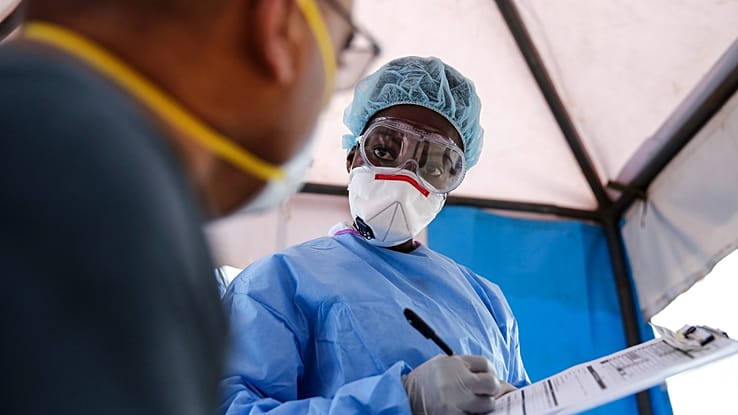
The Kenya Medical Practitioners, Pharmacists and Dentists Union has urged the national government to safeguard frontline health personnel following the confirmation of the country’s first Ebola case.
In a statement issued on Tuesday, the union’s secretary-general, Dr. Divji Atellah, emphasized that healthcare staff should serve as the primary line of defense rather than being left vulnerable in the response.
Health Minister Aden Duale confirmed on Tuesday that a 40-year-old Kenyan businessman had died from the virus after contracting it while residing in the Democratic Republic of Congo (DRC).
Duale informed journalists that the patient fell ill roughly a month ago and underwent initial care in the DRC. He subsequently traveled by land to Kampala, Uganda, before taking a flight to Nairobi on October 3 to seek further medical attention, where he ultimately passed away on Monday evening.
Following the announcement, Dr. Divji Atellah called on the government to respond with urgency, transparency, and responsibility. He stressed that medical personnel who made contact with the patient require immediate monitoring, psychological assistance, and appropriate medical follow-up.
Furthermore, the union advocated for extensive contact tracing alongside comprehensive hospital preparedness.
Kenyan health officials have traced 28 primary contacts, comprising relatives and medical staff, with no positive cases reported among them to date. Authorities are actively working to locate an additional 23 passengers and four crew members from the same flight, while confirming that quarantine isolation facilities are ready for high-risk individuals.
This event marks the first recorded case of Ebola within Kenya’s borders. Nearby Uganda had previously logged 20 cases, primarily linked to travel from the DRC, along with two deaths, before the country was declared free of the virus in August.
According to data from the World Health Organization through October 2, an outbreak of the Bundibugyo strain originating in the DRC—for which no specific treatment or vaccine currently exists—has resulted in 4,082 deaths across 8,463 recorded cases.
