



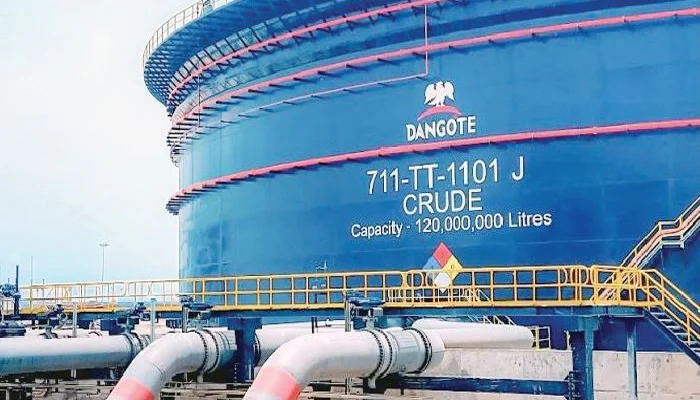
The Dangote Petroleum Refinery has shaken up the international energy market by exporting approximately 466,000 metric tonnes of jet fuel to Europe in June 2026. Valued at an estimated N757.25 billion, this massive volume allowed the Nigerian refinery to surpass shipments from the United States and other traditional suppliers to the continent.
This milestone marks the highest volume of aviation fuel Nigeria has ever sent to Europe since transitioning into a net exporter in 2024, the year the multi-billion-dollar refinery kicked off aviation fuel production.
According to a market report by S&P Global Commodity Insights, European jet fuel markets have faced bearish trends due to a sharp drop in prices following the highs seen during the Middle East conflict.
Despite the falling prices, Nigerian supplies surged dramatically, doubling from 232,000 metric tonnes in May to 466,000 metric tonnes in June.
This June volume translates to roughly 582.5 million litres of jet fuel, worth about N757.25 billion based on an estimated domestic value of N1,300 per litre.
In contrast, aviation fuel exports from the United States to Europe experienced a steady decline, dropping from a record 818,000 metric tonnes in April to 560,000 metric tonnes in May, and falling further to 399,000 metric tonnes in June. This downward trend allowed Nigeria to leapfrog the US as a primary supplier for the month.
Industry Insights
An anonymous market trader linked the current oversupply in Europe to the aggressive shipping volumes coming out of both the Dangote Refinery and the US, combined with high domestic production.
“Jet is oversupplied because of high local refinery production; refineries pushed back maintenance to make the most of the high prices.
“The US and Dangote also shipped large volumes. Now there are some flows resuming through the Suez, too, from the UAE, but let’s see how it goes,” the trader was quoted as saying.
Plunging Prices Amid High Supply
Data from Platts, a division of S&P Global Commodity Insights, reveals that the European jet fuel forward curve has weakened heavily. Traders are prepping for an oversupplied summer market as aviation demand remains lower than anticipated.
The Northwest Europe jet CIF cargo financial assessment for July plummeted to $981.75 per metric tonne on June 30, a steep fall from the record high of $1,694.25 per metric tonne seen on March 30. Similarly, August contracts dropped from $1,507.50 to $968.25 per metric tonne over the same period.
Europe is expected to see even more inflows in the coming months due to attractive East-West arbitrage windows, which are enticing exporters from India and the Middle East to send fuel westward.
While June saw no shipments from Kuwait or the United Arab Emirates, Saudi Arabia boosted its exports to Europe to 106,000 metric tonnes (up from 7,000 metric tonnes in May), and India’s shipments grew from 129,000 metric tonnes to 197,000 metric tonnes.
Two European jet fuel traders told Platts that the future of the market will largely hinge on how quickly Middle Eastern refineries bounce back from recent geopolitical conflicts, alongside developments in the Strait of Hormuz.
However, they noted that an increase in summer travel and a tendency for refiners to prioritize diesel over jet fuel could help stabilize the market.
Nigeria’s New Reality as an Export Hub
Data from the Nigerian Midstream and Downstream Petroleum Regulatory Authority (NMDPRA) highlights that Dangote exported roughly 1.66 billion litres of refined petroleum products back in April 2026, amid supply chain disruptions caused by Middle East tensions.
A breakdown of the NMDPRA April 2026 data shows Nigeria exported:
615 million litres of aviation fuel
534 million litres of automotive gas oil (diesel)
513 million litres of premium motor spirit (petrol)
As the only major functional refinery operating in Nigeria, the Dangote facility produces enough to comfortably satisfy both local demand and international export markets.
Thanks to this rising output, Nigeria has also become a net exporter of petrol for the first time in decades, having exported 434 million litres of petrol in March alone.
The latest export data underscores Nigeria’s successful shift from a heavy importer of refined petroleum products to a dominant energy export hub in Africa.
With ongoing instability disrupting traditional supply lines to Europe, Nigeria’s jet fuel exports are expected to climb even higher.


