

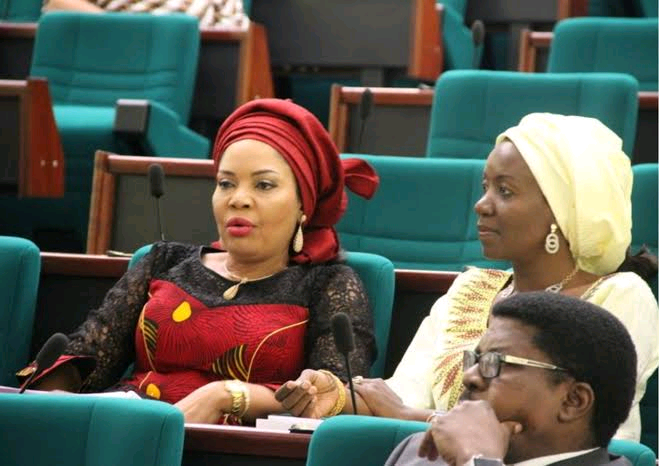
Nigeria’s lawmakers have proposed 74 additional legislative seats for women in the Senate and House of Representatives, alongside three reserved seats in each state House of Assembly.
This is part of the National Assembly’s fresh effort to address women’s underrepresentation in Nigerian politics.
Senate Leader, Opeyemi Bamidele, disclosed this on Monday at the 2026 Law Week of the International Federation of Women Lawyers (FIDA), Ekiti State chapter, held under the theme, “Justice in a Changing World: Responding to New Challenges Affecting Women and Children.”
Bamidele, who represents Ekiti Central Senatorial District, said the proposal was part of the ongoing review of the 1999 Constitution and was designed to improve women’s access to political representation without displacing existing elected lawmakers.
He explained that the proposed amendment would create 37 additional seats in the Senate and another 37 in the House of Representatives, giving each state and the Federal Capital Territory one extra seat in both chambers.
The Senate Leader, who is also Vice Chairman of the Senate Committee on the Review of the 1999 Constitution, said the committee had also proposed three additional seats reserved for women in every state House of Assembly.
According to him, the arrangement is expected to remain in place for 16 years, covering four electoral cycles, before a comprehensive review.
“A Bill for an Act to alter the provisions of the Constitution of the Federal Republic of Nigeria, 1999 to provide for special seats for women in the national and state Houses of Assembly and for related matters is receiving our attention at the National Assembly,” he said.
Bamidele described the proposal as the product of extensive consultations and consensus-building, stressing that the constitutional review was deliberately started early to allow for a thorough and inclusive process.
He said the proposed special seats were not a partisan initiative but a constitutional intervention to address the exclusion of women from decision-making.
“It is not a partisan endeavour. It is a historic imperative,” he said, arguing that a democracy that excludes a significant proportion of its population from political decisions risks undermining representative governance.
Bamidele added that the National Assembly was engaging state Houses of Assembly to secure the constitutionally required concurrence for the proposed changes.
He also acknowledged the advocacy of senior government figures, including the First Lady, Oluremi Tinubu, in strengthening support for greater women’s participation in governance.
Beyond political representation, the Senate Leader called for stronger laws and institutions to protect women, children and persons with disabilities, particularly in access to healthcare, education and social protection.
He said justice must be accessible, affordable, timely and effective, rather than remaining a promise in constitutional provisions and statute books.
“A woman who suffers domestic violence must be able to seek protection without intimidation or social condemnation. A child who experiences abuse must be heard, protected from further harm, and provided with appropriate support,” he said.
He called for improved access to legal assistance, medical care and psychosocial services for victims, while urging that perpetrators be held accountable in accordance with due process and the rule of law.
Bamidele also urged stronger collaboration among the legislature, executive, judiciary, law enforcement agencies, social welfare institutions, religious organisations, traditional rulers, civil society groups and the private sector to improve the protection of vulnerable Nigerians.
The Vice-Chancellor of Afe Babalola University, Ado-Ekiti, Prof. Smaranda Olarinde, called for stronger legal and institutional safeguards against emerging forms of abuse targeting women and children.
Olarinde identified technology-enabled threats, including cyberstalking, online harassment, deepfake images, impersonation and the exploitation of children, as growing concerns requiring coordinated action.
She called for collaboration among government institutions, universities, law enforcement agencies, the judiciary, the media and civil society organisations to tackle gender-based violence and child abuse.
