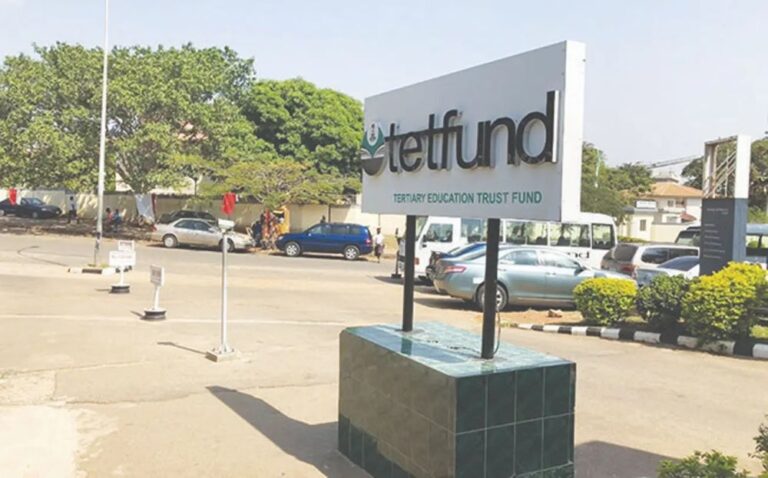

The Board of Trustees of the Tertiary Education Trust Fund has made it clear that higher education institutions with delayed or abandoned projects will be disqualified from receiving new allocations in the 2027 intervention cycle until all pending work is fully finished.
The directive was issued by Aminu Masari, Chairman of the TETFund Board of Trustees, and released through a statement by the agency’s Head of Public Relations, Abdulmumin Oniyangi.
Masari emphasized that this step was taken to stop the ongoing pattern of delayed project execution across beneficiary campuses. He described the decision as a final stand after observing that several schools repeatedly fail to meet agreed construction deadlines.
”The Board of Trustees has taken a final stand on the issue of delay in completion of approved projects in all its beneficiary institutions, warning that affected institutions will not get approval to commence new projects in the 2027 allocation cycle,” Masari said.
He noted that affected schools must redirect their current Annual, Zonal, and High Impact Intervention funding toward completing existing structures.
”No new projects will be admitted from the identified beneficiary institutions for the 2027 intervention cycle,” he stated.
Reflecting on past challenges, Masari acknowledged that price spikes in construction materials had previously halted progress, prompting the fund to release special funding in 2023 to bridge the financial gap.
”The reasons given for the unacceptable development were volatility in market prices of key building materials like cement, reinforcement bars, sanitary and electrical fittings, among others.
This informed the introduction of a new intervention line dedicated to completing the affected projects. A recent review confirmed that the initiative yielded the desired result as many of the affected projects have been completed following this intervention,” he said.
However, despite that intervention, fresh delays have continued to emerge. Masari pointed out that recent bottlenecks stem from administrative issues and institutional management rather than a lack of money.
”The continued occurrence of non-adherence to stipulated timelines in completing TETFund-sponsored projects is unacceptable,” Masari said.
”Lack of continuity in project implementation by heads of beneficiary institutions who prefer to start new projects, as well as delays in processing payments to contractors handling the projects, are largely responsible for the avoidable development,” he added.
He made it clear that internal campus politics and bureaucracy would no longer be allowed to stall agency-funded work.
To resolve the problem, the board outlined mandatory actions for all institutions.
”Under the new directive, all beneficiary institutions must compile comprehensive lists of projects that have exceeded their completion timelines by more than six months, identify the causes of the delays, and propose practical remedies.
The institutions are also expected to rank the affected projects according to priority, provide detailed cost estimates required for their completion, and establish stronger project supervision mechanisms involving their Physical Planning and Maintenance Departments,” he said.
Monitoring teams made up of board members and technical experts will tour campuses in August and September 2026 to inspect stalled projects firsthand.
”The inspection reports and proposals submitted by institutions would be reviewed during the board’s statutory meeting scheduled for October 2026, where projects eligible for inclusion in the 2027 disbursement guidelines would be considered,” he stated.
TETFund operates under the Tertiary Education Trust Fund Act and is financed through an education tax collected from registered Nigerian companies. It serves as the primary funding body for infrastructure, research, faculty training, and library development across public universities, polytechnics, and colleges of education nationwide.
While the agency has funneled hundreds of billions of naira into state-of-the-art educational facilities over the years, lingering project delays and leadership turnover have long hindered impact. This new policy signals a firm stance to ensure public funds yield completed, operational facilities rather than abandoned structures.
Trending
- Sudan conflict, neglect threaten Ancient Meroe Pyramids with collapse
- Super Falcons book quarter-final date with Cameroon after Egypt rout
- Africa Business & Investment Expo 2026 returns bigger, as Ayanda Media Network, Dotmount Communications unite to drive Africa’s Investment Future
- Crackdown on Malpractice: WAEC locks down over 167,000 results in latest computer-based WASSCE
- Red Cross urges immediate aid as Sudan war escalates across all fronts
- US, Iran and Oman near interim deal to reopen Strait of Hormuz, Trump says agreement could come within days
- Fifa council members push for accountability meeting as Infantino faces mounting revolt over abandoned investment plan
- Global Health Agency urges action as DR Congo Ebola outbreak escalates
No Fresh Funds: TETFund To block 2027 grants for tertiary schools with unfinished projects