

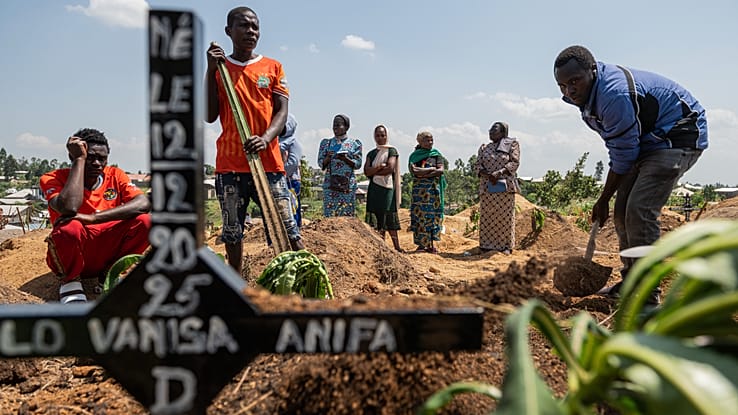
More than 300 children have lost their lives to Ebola since the latest outbreak emerged in the Democratic Republic of Congo, United Nations deputy spokesperson Farhan Haq reported on Friday.
Citing figures from UNICEF, Haq noted that while children make up roughly a quarter of all confirmed Ebola cases, they account for nearly one-third of the total fatalities.
The epidemic continues its rapid expansion across eastern DRC, with total cases climbing past 4,000 and the official death toll reaching 1,850.
Beyond direct infections, the crisis is severely weakening access to basic medical care. In regions hit hardest by the virus, overall health service usage has dropped by over 40 percent in recent months as fear of contracting the disease deters patients from visiting clinics.
Expectant mothers face growing risks under these conditions. Data from the UN Population Fund indicates that maternal deaths in Ituri province have nearly doubled since the outbreak started, averaging roughly six women dying each week from complications during childbirth. Experts also emphasize that catching Ebola while pregnant remains tied to an almost universal risk of fetal loss.
In response to the evolving situation, the WHO Technical Advisory Group on Vaccine Research has advised conducting a clinical trial in the DRC to test the Ervebo vaccine against the Bundibugyo strain. Ervebo stands as the only officially licensed vaccine for Ebola, and the WHO is coordinating with international partners to launch the trial as quickly as possible.
Following a visit earlier this week to the outbreak’s epicenter in Ituri province, WHO officials stressed the urgent need to expand community-led health measures, emphasizing earlier case detection, systematic contact tracing, and improved access to treatment.
To fight widespread fear and misinformation, health authorities have deployed 13,000 community workers through a joint initiative involving the Ministry of Public Health, WHO, Africa Centres for Disease Control, UNICEF, and other partners. These teams have conducted more than 500,000 home visits, delivering prevention and early detection guidance to over 2.4 million residents.
