
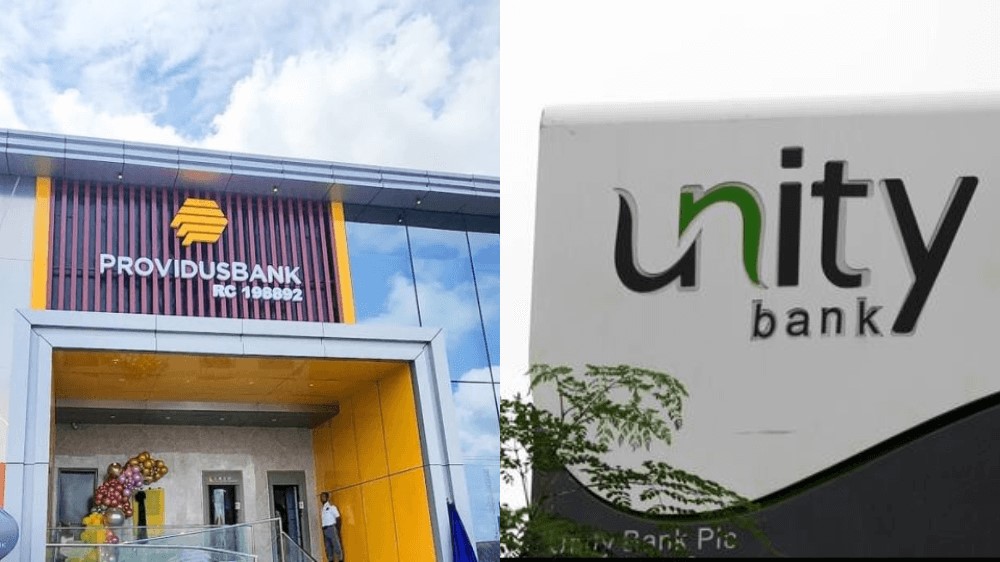
The Supreme Court has delivered a final verdict on the legal dispute surrounding the merger of Providus Bank Limited and Unity Bank Plc. On Monday, the apex court dismissed an appeal that sought to block the transaction and ordered the appellants to pay N10 million in costs to each respondent
The ruling was passed down by a five-member Supreme Court panel, led by Justice Tijani Abubakar, in Appeal No. SC/CV/132/2026. This case originated from Appeal No. CA/LAG/CV/137/2025 and Suit No. FHC/L/MISC/734/2025.
In a significant legal move, the court dismissed the appeal for lacking merit and utilized its powers under Section 22 of the Supreme Court Act to directly approve the merger between both financial institutions. This decision effectively ends all ongoing court cases connected to the business combination
As a result, the court mandated that all assets, liabilities, and business undertakings of Unity Bank Plc, including its physical properties, be transferred to Providus Bank Limited as outlined in the approved Scheme of Merger. This transfer must be completed within 10 days of the court’s approval.
Under the agreed terms of the merger, the Supreme Court cleared a payout structure of N3.18 per share, or 18 Providus Bank shares (valued at 50 kobo each) for every 17 Unity Bank shares held by investors.
Furthermore, the court ordered the immediate dissolution of Unity Bank Plc’s board of directors without liquidating the institution itself. The combined financial entity will now operate under a new corporate name: ProvidusUnity Bank Limited.
The panel finalized its decision by throwing out the unmeritorious appeal entirely and imposing the N10 million fine in favor of each respondent.
The legal challenge was initiated by Suleiman Abubakar and Mohammed Goni Modu, who are customers and shareholders of the banks.
They had filed multiple lawsuits trying to stop the consolidation, starting at the Federal High Court, moving through the Court of Appeal, and finally reaching the nation’s highest court.
Reacting to the ruling, Unity Bank Plc’s senior counsel, Chief D.D. Dodo, SAN, alongside R.O. Atabo, SAN, praised the judgment as a historic landmark that resolves all disagreements over the transaction. Dodo noted that the Supreme Court’s direct action has cleared every remaining legal barrier.
“What the Supreme Court has done by this judgment is to bring closure to the merger between Providus Bank and Unity Bank. Some persons went to the Federal High Court and attempted to truncate the merger, and the matter progressed through the Court of Appeal to the Supreme Court. Today, that chapter has been conclusively closed,” he said.
READ MORE: Cash crunch looming as POS operators threaten nationwide service shutdown over market practices
The Senior Advocate of Nigeria highlighted that the ruling is particularly remarkable because the apex court invoked Section 22 of the Supreme Court Act, a power rarely deployed in situations like this.
He suggested that this might be the very first time in Nigeria’s legal history that the Supreme Court has directly sanctioned a banking sector merger instead of sending the case back to a lower court for re-evaluation.
Dodo explained that the justices recognized the broader financial and public interest at stake, especially regarding economic stability, safeguarding customer deposits, and keeping banking services running smoothly.
“The Supreme Court realised that this merger is crucial to the national economy. It affects people’s lives, protects depositors’ funds and supports the policy of building stronger banks capable of sustaining commercial activities without disruption,” he said.
He added that the verdict boosts confidence in current regulatory reforms focused on enhancing bank capitalization and encouraging consolidations.
The transaction is tied to the banking sector recapitalization policy launched by the Central Bank of Nigeria (CBN). This policy advises financial institutions that cannot meet the new capital benchmarks on their own to seek mergers, acquisitions, or strategic partnerships.
Dodo called the recapitalization policy a forward-thinking strategy to build highly resilient banks that can protect customer funds and fuel economic growth. He also praised CBN Governor Olayemi Cardoso for driving these reforms, noting that the initiative has earned positive feedback from international financial institutions.
“The Supreme Court has now brought its full authority to bear on the matter and has finally brought it to a conclusion,” he said.
The respondents listed in the appeal were Providus Bank Limited, Unity Bank Plc, PAC Capital Limited, Vetiva Advisory Services Limited, Lighthouse Capital Limited, Planet Capital Limited, the Corporate Affairs Commission, the Federal Competition and Consumer Protection Commission, the Securities and Exchange Commission, and the Central Bank of Nigeria.
