



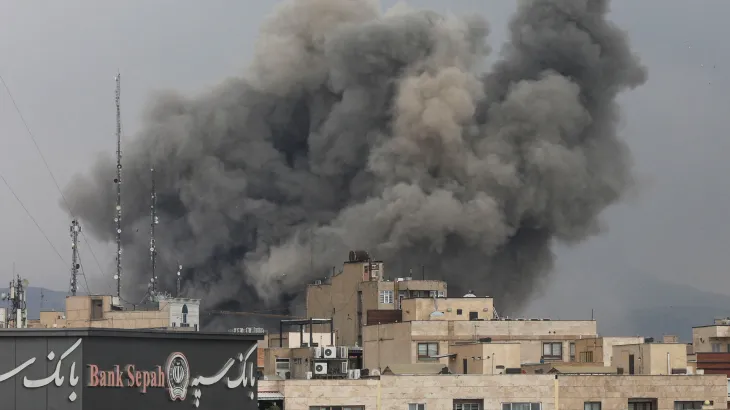
Iranian authorities have vowed to retaliate if the United States follows through on threats targeting critical energy infrastructure, as military strikes continue to intensify across the region.
Major General Ali Abdollahi, commander of Iran’s wartime military command, issued a direct warning regarding Washington’s strategy. He argued that the US is using neighboring capital, resources, and infrastructure as a shield for its own interests while strengthening Israel’s war capabilities.
“The United States is moving at an accelerating pace to fan the flames of a full-scale regional war,” Abdollahi stated.
Addressing nations in the surrounding region, he cautioned against continued alignment with Washington.
“It is hereby stated explicitly: Muslim countries must, with foresight, monitor America’s crimes and reconsider their cooperation and alignment with the US. Otherwise, any country that makes itself a defensive shield for criminal, aggressor America will burn in the fire of war,” Abdollahi warned.
Looming Infrastructure Attacks and Strategic Limits
The official warnings follow reports from major US media outlets indicating that American and Israeli forces may be preparing an extensive wave of attacks against Iran’s civilian power grid and petrochemical plants.
Anonymous sources indicate President Donald Trump has not yet given final authorization for the proposed two-week campaign, which aims to disrupt electricity across Tehran and create national instability.
At the same time, defense capacity constraints may be influencing operations. Analysis from the Center for Strategic and International Studies notes that persistent combat has drained US missile interceptor stocks, bringing Patriot inventories below 1,000 and THAAD reserves to around 250.
In response to potential operations, Iranian state-aligned Tasnim news agency cited an unnamed source confirming that military forces have organized a retaliatory strategy against the “potential madness” of the US by targeting “vital infrastructure” linked to both American and Israeli assets.
Israeli Stance and Regional Impact
Israeli Defence Minister Israel Katz highlighted the target strategy during a security conference broadcast on Channel 14, while acknowledging American hesitation.
“we very much want to strike Iran’s energy targets.
“The United States is not approving it at present, because of concern that Iran would strike neighbouring countries and there would be a global oil crisis,” Katz explained, adding that Israel was prepared to “set Iran back 40 years”
Since full-scale hostilities broke out on February 28, strikes on Iranian military and civilian sites have added severe pressure to a country of over 90 million people already navigating economic contraction and energy shortages.
Ongoing Strikes Across the Region
In retaliation, the Islamic Revolutionary Guard Corps (IRGC) and regular Iranian military forces have launched missile and drone attacks against US and Israeli facilities, as well as energy infrastructure across Saudi Arabia, the United Arab Emirates, Qatar, Kuwait, Bahrain, and Oman.
Recent regional developments include:
Overnight US strikes across five Iranian provinces targeting IRGC command structures, air defense, and coastal surveillance sites, which resulted in military and civilian casualties.
Kuwait’s air defenses intercepting multiple Iranian drones in national airspace, with minor damage reported to civilian vehicles and state assets.
Maritime attacks off Oman damaging at least two vessels, accompanied by Iranian state media broadcasts showing proximity footage of a struck ship and calling it “the smoke of mistakenly trusting the US” guarantees of safe passage through the Strait of Hormuz.
Iranian authorities turning back four unapproved vessels, maintaining tight restrictions on the transit corridor.
Drone strikes in Iraq targeting Iranian Kurdish opposition groups, alongside a reported refinery fire in Erbil, Iraqi Kurdistan.


