

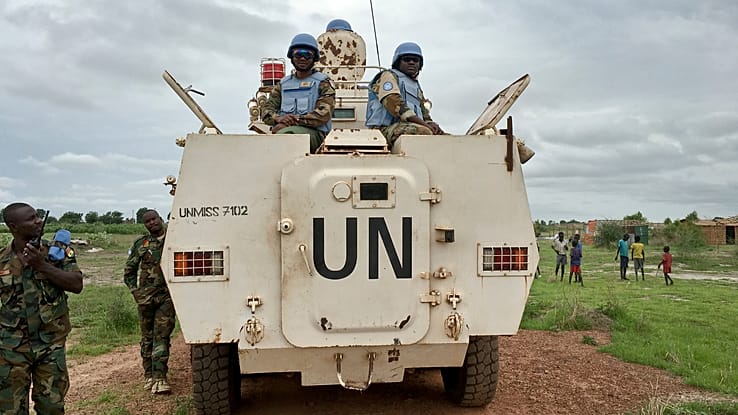
The United Nations Mission in South Sudan (UNMISS) has postponed the closure of its base in Unity State to address ongoing security concerns and looming natural disasters.
The decision follows a March 1, 2026 attack on the remote town of Abiemnhom, where heavy gunfire forced thousands of residents to seek safety at the nearby UN compound. Mongolian peacekeepers opened the gates, offering shelter and medical care to dozens of injured individuals. Months later, families are still attempting to rebuild homes and crops lost to burning and looting, while continuing to live under the threat of renewed violence.
In response to the situation, UNMISS chose to keep the base open despite financial constraints. The mission is conducting regular patrols, holding discussions with local leaders, and assisting with peace and reconciliation efforts.
Anita Kiki Gbeho, Special Representative of the Secretary-General and Head of UNMISS, visited the region to inspect the situation and meet with local leaders, residents, and peacekeepers.
“In Abiemnhom, it was around the fact that they were concerned we would leave and that, as a community, they would be vulnerable without us. I assured them that the UN has a mandate to protect civilians, so we would stay with the people of Abiemnhom, but did encourage them and promised them that we would support them in trying to find solutions to the communal violence that was taking place,” Gbeho said.
Beyond security challenges, Unity State faces severe environmental threats. Upcoming heavy rains during an anticipated El Nino cycle raise concerns about catastrophic flooding and potential droughts. The area has struggled with extreme water levels since major floods in 2019 left Bentiu town surrounded by water. Expanding floodwaters threaten the network of dykes built and maintained by UNMISS engineers and humanitarian groups to safeguard displaced families and local residents.
Local leaders emphasize that external help is necessary to maintain infrastructure, improve drainage, and plan evacuation routes before water levels peak.
“The biggest challenge is to deal with the flooding because communities are vulnerable,” explained Nyier Gatchang Pouch, Community High Committee Chairperson in the Bentiu displacement camp. “We cannot access or provide a mechanism to block the flooding unless there is intervention from UNMISS or the Government.”
Pouch added that local residents lack the means to address the rising water on their own.
“Communities have no possibility by themselves to do anything. We have no capacity to construct dykes. We have no capacity to do anything because the water is beyond the level,” Pouch stated.
UNMISS personnel continue working alongside local populations to prepare for environmental risks and bolster community safety. Addressing the complex crisis, Gbeho pointed to a central requirement for progress.
“When we talk about overcoming the multitude of concerns, my answer is that the foundation for this lies in peace,” Gbeho said.
