

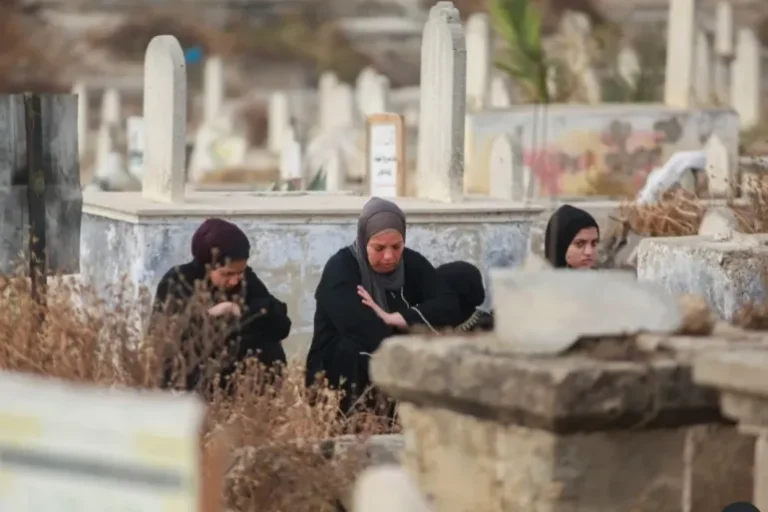
Omar al-Sawhi, 20, faced the difficult task of finding a burial place for his 40-year-old father, Mohammad, who was shot in the neck on June 10 while working at a roadside coffee stall near the Israeli-designated Yellow Line in Gaza.
Upon arriving at Zeitoun Cemetery in Gaza City, Omar found the grounds completely packed, with graves marked only by stones and paper name tags due to severe material shortages and war conditions.
“I stood in the middle of the cemetery and saw so many graves. There were mountains of sand, with people buried underneath,” Omar told Al Jazeera. “A grave was just a stone with a piece of paper bearing the name of the martyr, without the grave being built or properly prepared as it was before the war.”
With standard graves costing around 500 shekels ($167)—an amount his family could not afford—and no open plots remaining, Omar’s family was forced to bury Mohammad inside his grandfather’s existing grave.
The breakdown of basic services and ongoing military attacks have left thousands of deceased Palestinians unaccounted for or buried in temporary locations such as gardens, school grounds, hospital yards, and displacement camps. Following a relative drop in violence after the United States-brokered ceasefire in October 2025, many families began exhuming loved ones to give them proper burials. At least 1,200 Palestinians have been killed since the ceasefire announcement, and authorities in Gaza report recovering 529 bodies from seven mass graves on hospital grounds alone. Mohammad’s family took advantage of a temporary lull to excavate his initial remains and transfer them to a permanent site.
The shortage of burial space is driven both by the high death toll—over 73,000 Palestinians killed since October 2023—and the widespread destruction of existing facilities. According to Gaza’s Ministry of Endowments and Religious Affairs, more than 40 cemeteries have been destroyed during the conflict. Additionally, strict access limits imposed by Israeli forces in controlled areas have further restricted available grounds, while land previously set aside for cemeteries now serves as shelter for displaced populations.
Scarcity has also driven up costs. Authorities note that burial prices now range between 700 shekels ($235) and 1,000 shekels ($335). Families routinely rely on rubble, mud, or corrugated metal sheets as makeshift markers until they can afford proper headstones.
Ikrami al-Madallal, a media official at the Endowments Ministry, explained that many of Gaza’s 60 cemeteries were already at capacity before the conflict began.
“We need to establish new cemeteries because of the shortage of available burial space,” he told Al Jazeera, noting that transferring remains requires strict coordination between the ministry and local government bodies.
Gravediggers face unprecedented pressure. Tafesh Abu Hatab, 50, who has worked in the field for 19 years, stated that the Khan Younis Cemetery held around 60 graves at the start of the war but now contains 6,000. At peak periods, he prepared up to 35 graves a day.
“We have never experienced a period of bloodshed this devastating,” he told Al Jazeera. “Not a day passes without dozens of martyrs being buried.”
Abu Hatab added that many of the casualties he buries are women and children, often from entire families killed in single strikes on buildings, tents, or vehicles.
“They destroy our homes over our heads, and from the rubble of those homes, we build our graves,” he said.
