



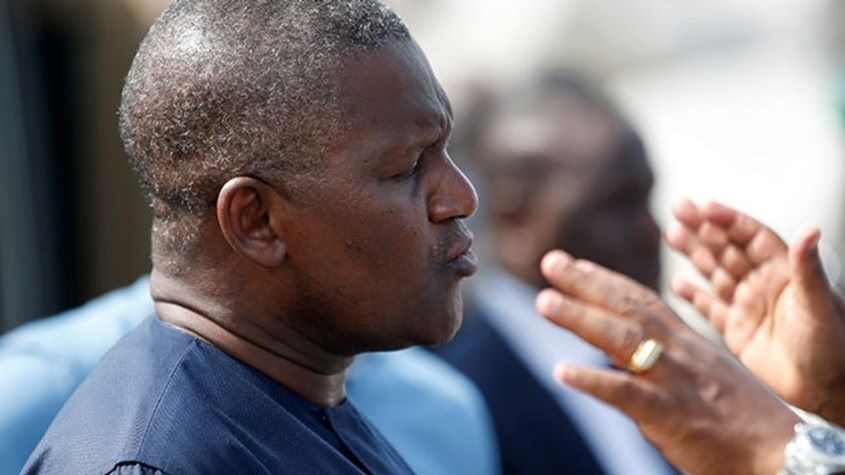
Aliko Dangote, President of the Dangote Group and Africa’s richest man, has accused local marketers and international oil corporations of inciting protests against land acquisition for his proposed $16 billion refinery in Lamu, Kenya.
Despite a court order halting construction operations due to an ongoing land conflict, Dangote and Kenyan President William Ruto led the official groundbreaking ceremony for the facility on Wednesday.
Addressing the demonstrations by local residents over land compensation during an interview on BBC’s Focus on Africa, Dangote rejected assertions that his firm had seized excess land, asserting that the company solely occupied the area designated by the Kenyan authorities.
“They said some people are demonstrating; demonstrating about what? Have you ever seen people demonstrating against themselves in terms of development?” he asked.
He brushed aside the opposition as “games played by local marketers and international players”, affirming that the construction of the facility will move forward toward its scheduled completion in 2030.
The proposed plant, set to become East Africa’s largest refinery with a capacity of 700,000 barrels per day, stands as Kenya’s largest infrastructure enterprise since independence, outscaling the $5.1 billion Standard Gauge Railway. Leaders from Uganda, Togo, Ethiopia, and Benin attended the event, with Dangote extending a collective 30 percent equity offer in the venture to regional governments.
Describing the project as his most significant foreign investment outside Nigeria, Dangote noted that the initiative aims to build upon the success of his mega-refinery in Lagos.
“Lekki proved that it can be done, Lamu must prove that it can be repeated,” he said.
Meanwhile, environmental and community advocacy group Save Lamu has raised concerns regarding the ecological implications of the mega-project. Group co-founder Walid Ali informed the BBC that residents are requesting full disclosure of the environmental impact assessment along with corresponding mitigation plans.
Legal action initiated by 133 Lamu residents led the Kenyan High Court to restrict site activities, including excavation and general building, pending a court session set for October 14.
In response to local concerns, Dangote highlighted that the development will generate roughly 60,000 jobs during peak construction. The complex will also house a 1,000-megawatt power generation facility intended to power the refinery and supply surrounding industrial setups.


