



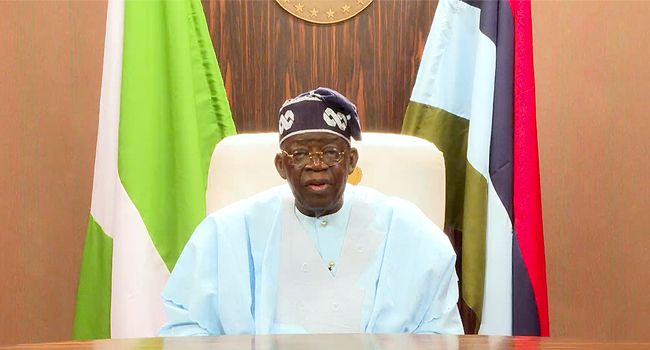
Marking 66 years of national sovereignty, President Bola Ahmed Tinubu delivered an Independence Day address asserting that Nigeria has successfully altered its economic trajectory following three and a half years of rigorous structural reforms. He declared that the country has moved past emergency measures and entered an “age of prosperity.”
Reflecting on the nation’s journey since the flag was first raised 66 years ago, Tinubu noted that the original promise to build a united, strong, and prosperous country had been tested by war, military rule, economic crises, insecurity, and political upheaval. He praised the resilience of ordinary citizens—including farmers, traders, teachers, and young entrepreneurs—alongside the Armed Forces for sustaining the nation through hardship.
Addressing the choices of the past, the President stated that previous leadership had long avoided necessary economic decisions, allowing deep distortions to grow.
“By 2023, poverty was rising, and hope was nearly gone. The country’s situation was darker than ever. We had no choice but to act,” he said.
Comparing Nigeria’s economic state at the time to a cancer patient needing tough treatment rather than temporary pain relief, Tinubu defended his administration’s policy choices.
“For too long, Nigeria’s leaders chose morphine while praying for a miracle that never came,” he said.
“Our reforms did not create the weaknesses in our economy. They confronted them,” he said, warning against calls to abandon the policies and return to past subsidy regimes.
Highlighting economic indicators, the President stated that the economy grew by over four percent in the past year through contributions from both oil and non-oil sectors. He cited reduced oil theft, a notable drop in inflation from its peak, rebuilt foreign reserves, and a stabilized foreign exchange market. Additionally, non-oil export earnings exceeded $6 billion in 2025, marking the highest level in the nation’s history.
“This is real money being made by real Nigerian businesses,” he said.
Declaring that the foundation has been repaired, Tinubu announced a shift in administration focus toward shared economic growth.
“For three years, our overriding purpose was to correct our nation’s course. Now, our purpose is simple: shared and widespread prosperity,” he said.
To lower the cost of living, the President outlined strategies centered on expanding mechanized irrigation, dry-season farming, seed and fertilizer access, and transport infrastructure.
“Our logic is simple,” Tinubu said. “When a farmer produces more cheaply, when fewer crops are lost between the farm and the market, when a manufacturer spends less on electricity, when a truck reaches its destination faster, and when the business environment fosters fair competition, all those savings will ultimately find their way into the price of goods in the market.”
He further emphasized that job creation, enterprise, and industrial expansion remain central priorities.
“I want to see more Nigerians making things. I want to see more Nigerian farms feeding our cities and supplying our factories. I want to see Nigerian businesses selling Nigerian goods to the whole world. I want young Nigerians building unicorns and creating opportunities for others here at home,” he said.
Acknowledging ongoing household struggles, the President noted that multi-generational structural deficits cannot be erased overnight.
“We cannot erase in four years what accumulated over generations. But we can change its course,” he said.
To cushion the transition, Tinubu highlighted government interventions, including direct support for vulnerable households via the National Social Register, tertiary education funding through the Nigerian Education Loan Fund, and consumer finance access via CREDICORP. He also cited regular salary and pension payments alongside investments in primary healthcare and basic education.
“Since 2023, we have paid salaries and pensions on time and in full. We have reformed the national pension program to benefit retirees and the vulnerable,” he said.
“Our objective is not to manage poverty more efficiently. We will defeat it,” he declared.
Concluding his address, President Tinubu urged citizens to maintain momentum as the country embarks on this next phase.
“The age of reform has done its work. Now begins the age of prosperity,” he said.
“We have travelled through difficult years together. We have made hard decisions together. And now, still together, we must build the country those decisions have made possible,” he said.
“Nigeria has corrected its course. We have passed through our own Red Sea. This is not the time to look back,” he said.
“The Promised Land before us is a Nigeria of abundance and opportunity; a nation where prosperity is broadly shared, where every child can dream beyond the circumstances of his birth, and where our country’s immense promise is finally reflected in the lives of our people,” Tinubu said. “Our destination is in sight. Our foundations are strong. Our direction is clear. So let us go forward. No looking back.”
He closed by extending Independence Day wishes to all citizens and offering prayers for the Federal Republic of Nigeria.


